
A seller in Dundalk once sat on a signed listing agreement for six weeks because her attorney’s paralegal never called her back. She wasn’t stuck because of the law. Nobody had told her which door to knock on, and the mortgage kept coming due while she waited.
Selling a Maryland house during Chapter 13 trips people up in exactly that way, even though the rules are knowable. Once you know who signs off on what, the process stops feeling like a locked door.
Can I Sell My House If I Filed Chapter 13 in Maryland?
Plenty of homeowners start a repayment plan believing the house is locked up until the last payment clears, three to five years down the road. Your name stays on the title, the mortgage stays in your name, and you keep living there. Still, the property belongs to the bankruptcy estate while the Chapter 13 case is open. Any sale outside the ordinary course of business generally needs notice and a hearing. Section 1303 gives you, not the trustee, the power to make that sale.
The court holds the keys to the gate.
Nothing else I could tell you here matters as much as that distinction. You keep possession and control of your property, yet you’ll still need permission from the court and the trustee before a sale goes through.
Maryland homeowners usually file Chapter 13 for one reason: to stop a foreclosure auction and catch up the arrears over time. Then life shifts. Maybe a job moves, or the roof needs twenty thousand dollars nobody has.
A few years back I bought a house in Glen Burnie from a widow who was three months behind with an auction date already on the calendar. Her late husband’s woodworking bench still took up half the garage, and she’d been afraid to touch anything. We worked with her attorney, the sale went through the proper channel, and she kept what the law let her keep.
Selling during the case isn’t a loophole. It’s a documented step inside your own bankruptcy.
How Does Chapter 13 Affect a Home Sale in Maryland?
Tell your buyer up front that the house is tied to a bankruptcy case. People who find out at the title table tend to walk away. Anyone who learns about it on day one has time to plan around the court’s calendar.
Your plan shapes the sale in ways a normal Maryland closing never has to handle, and the trustee mostly wants to know one thing. Will unsecured creditors end up at least as well off as the confirmed plan promised them?
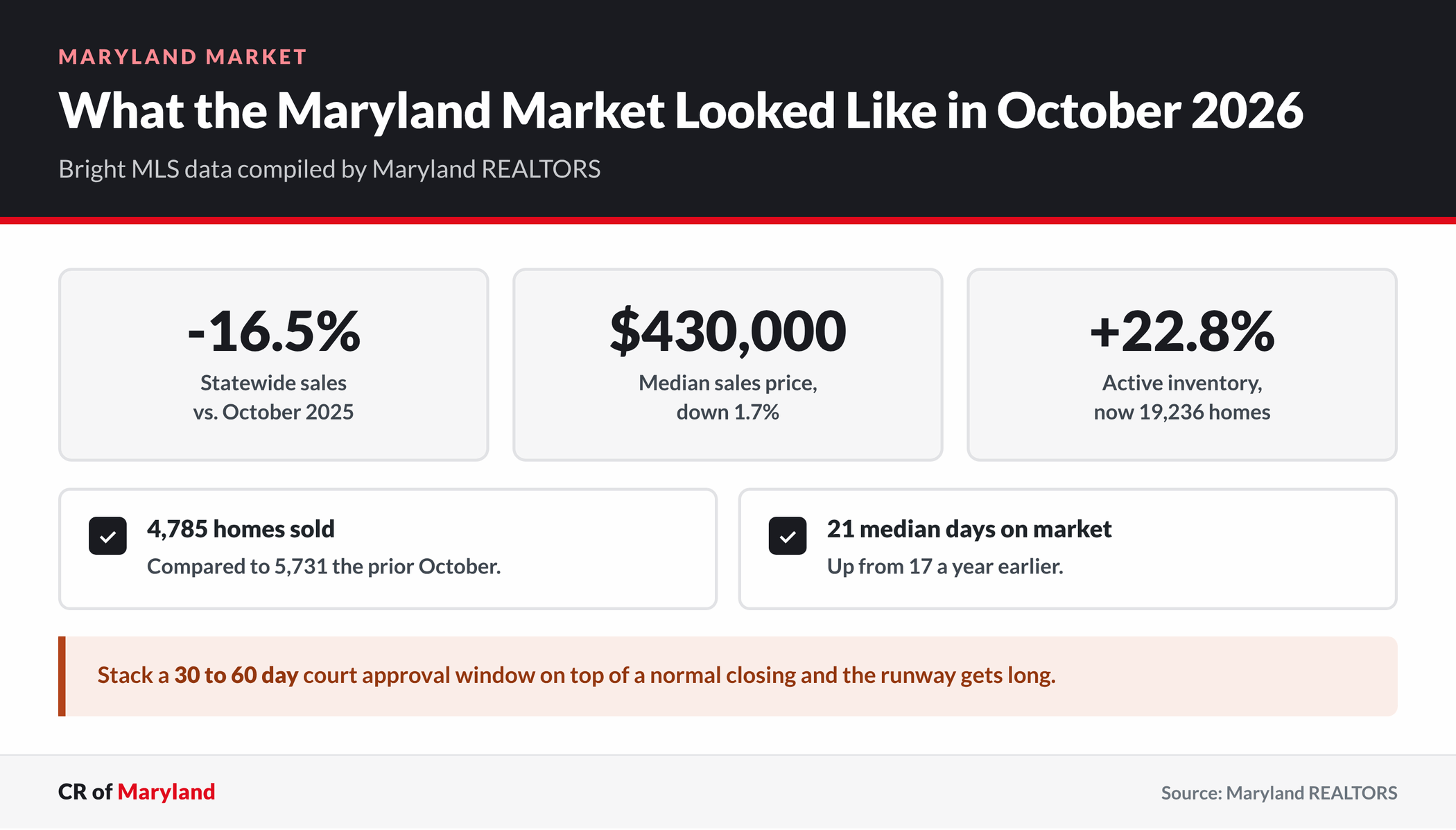
Timing changes too. A motion-to-sell process typically takes 30 to 60 days from filing the motion to court approval, depending on objections and hearing schedules. Stack that on a normal closing period and your runway gets longer than many Maryland sellers plan for.
Does that runway fit the current market? Maryland sales took a hard hit this fall. Statewide sales fell 16.5% in October 2026 from a year earlier, with 4,785 homes sold against 5,731 the prior October. Maryland REALTORS® reported from Bright MLS data that the median sales price slipped 1.7% to $430,000. Active inventory climbed 22.8% to 19,236 homes, and median days on market went from 17 to 21.
That combination punishes indecision.
One more wrinkle: your ongoing plan payments don’t pause during the contract period. Miss them during the sale and you’ve traded one crisis for another.
What Does the Automatic Stay Mean for Your Chapter 13 Case?
Think of the stay as a pause button with conditions. Filing Chapter 13 triggers the automatic stay, which halts collection activity and puts the house under the bankruptcy court’s supervision. With creditors on hold, the trustee reviews any proposed sale and the court approves it on a motion your attorney files.
Maryland’s foreclosure process gets stopped mid-stride by the stay. The district’s local rules even cover what a party must do after a foreclosure sale on Maryland real property. One step is giving the auditor the bankruptcy trustee’s name and address. You can read the full set of rules on the U.S. Bankruptcy Court for the District of Maryland site.
Don’t treat the stay as permanent. Let your plan payments lapse and a lender’s motion for relief from the stay can land fast. I’ve watched cases unravel from Hagerstown to Salisbury. The plan was usually fine, and nobody had warned the homeowner how little margin there was.
If you already know you can’t carry the house long term, using Chapter 13 purely to stall a Maryland auction date wastes the stay’s best feature. What the stay really buys you is time to carry out a plan. It can mean catching up, or it can mean selling on your own terms instead of the auctioneer’s.
Do I Need Court Approval to Sell My Maryland House in Chapter 13?
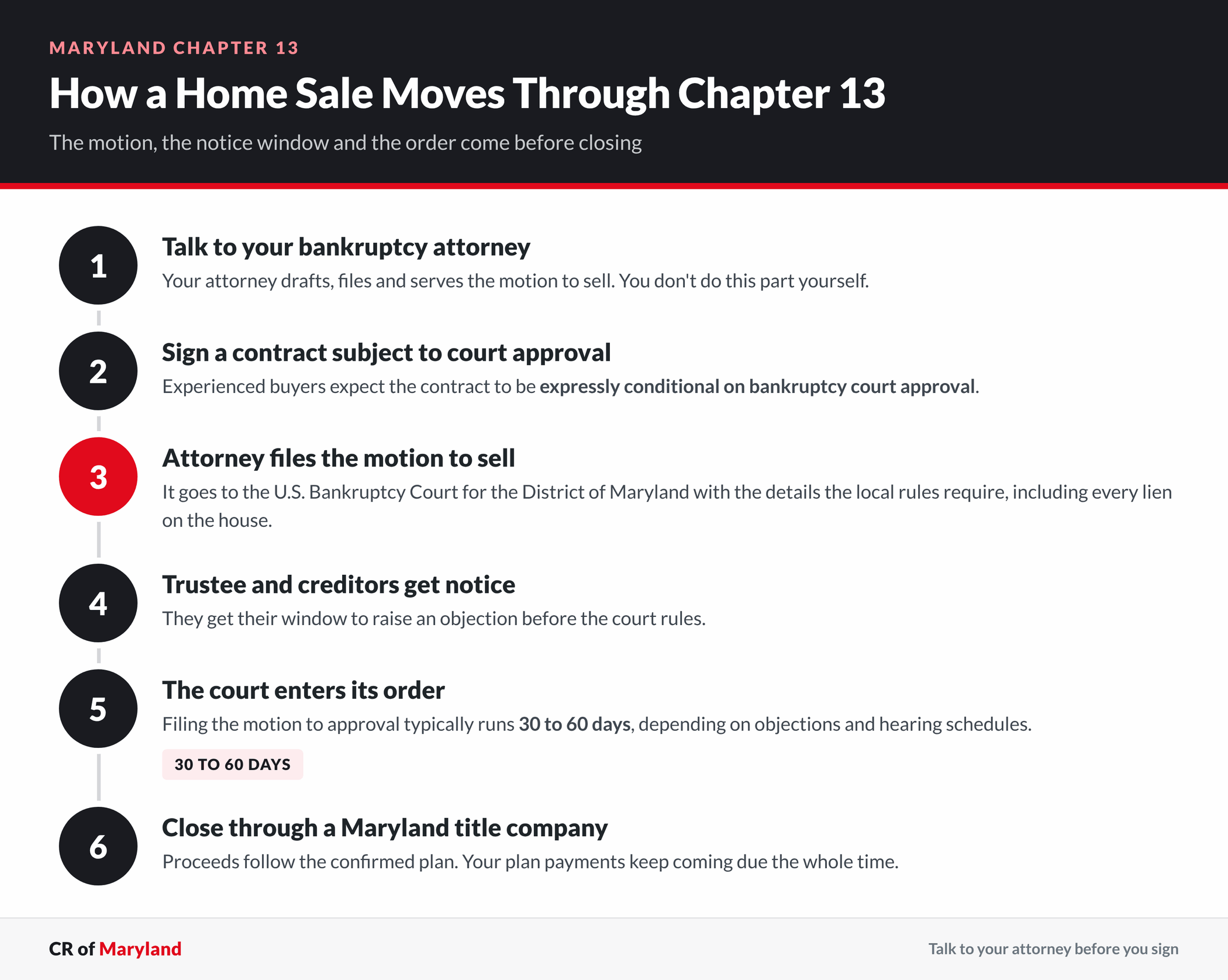
Yes, and the trustee gets a say even without holding the selling power. Under 11 U.S.C. § 1303, that power belongs to you as the debtor, exclusive of the trustee. Your attorney files a motion to sell, and creditors and the trustee get a window to object.
Our district adds its own paperwork. Local Bankruptcy Rule 6004-2 covers sales of property with a lien on it in Chapter 7, 12 and 13 cases. The motion to sell must include everything listed in Local Bankruptcy Rule 6004-1(a) through (i). It also needs a description of every lien, claim or interest against the property. When secured claims won’t be paid in full at closing, a separate notice sets a deadline for lienholders to file or amend proofs of claim. By rule, it has to fall at least twenty-one days after the sale’s closing date.
Translation for a Maryland kitchen table: underwater sales carry extra paperwork.
Buyers who’ve done this before want the condition in writing. Making the contract expressly conditional on bankruptcy court approval is standard, and they plan around that clause. Someone who balks at it has probably never closed a sale like this and shouldn’t be your buyer.
Paying cash doesn’t bypass the court. The same motion, approval and payout rules apply no matter who buys the home. We buy this way at CR of Maryland, with proof of funds your attorney can attach to the motion to sell. Our closing date waits out the objection period without falling apart.
What Happens to Sale Proceeds When You Filed Chapter 13 in Maryland?
A homeowner in Catonsville once figured she’d walk away with a five-figure check. She netted a fraction of that, because the arrears, two liens, and the plan’s required distribution came out first.
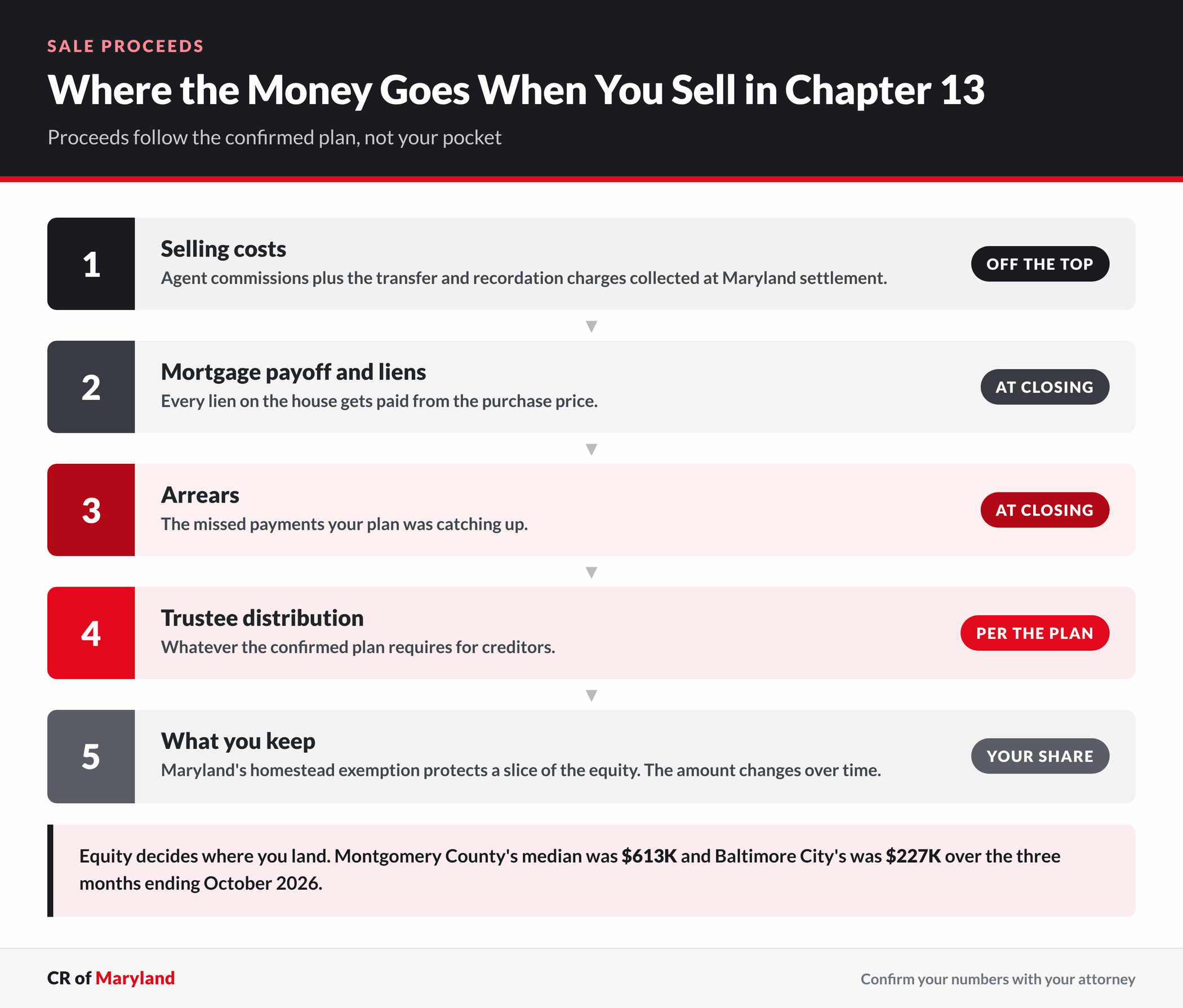
Money from the sale doesn’t land in your pocket by default. In Chapter 13, the proceeds follow the confirmed plan. Arrears, liens and the trustee’s distribution get paid from the sale price at closing.
Where you land depends on equity, and Maryland equity swings hard from county to county. Montgomery County’s median sale price over the three months ending October 2026 was $613K, down 0.34% year over year. Baltimore City’s median over the same stretch was $227K, down 2.5%. A Rockville split-level and a Pigtown rowhome lead to very different conversations with a trustee. One has a cushion to protect, and the other may have almost none.
Thin equity makes the sale mostly about stopping the bleeding, and the trustee’s math gets simpler. Strong equity in a place like Bethesda or Annapolis is another story. There, the trustee will look hard at whether unsecured creditors should get more than the original plan promised.
Exemptions matter here. Maryland’s homestead exemption protects a slice of that equity, and the amount changes over time. Guess wrong by a few thousand dollars and you’ll walk away with a different number. Ask your lawyer for the current figure and how it applies to your house.
Agent commissions, payoffs, and the transfer and recordation charges collected at Maryland settlement all come off the top. Only then does anyone argue about the rest.
Will Selling My House Hurt My Chapter 13 Repayment Plan?
Forty-nine days is the average time a Baltimore home spends on the market as of October 2026, up from 45 days a year earlier. Add the court approval window, and a listed sale inside an open case can run close to four months from yard sign to payout.
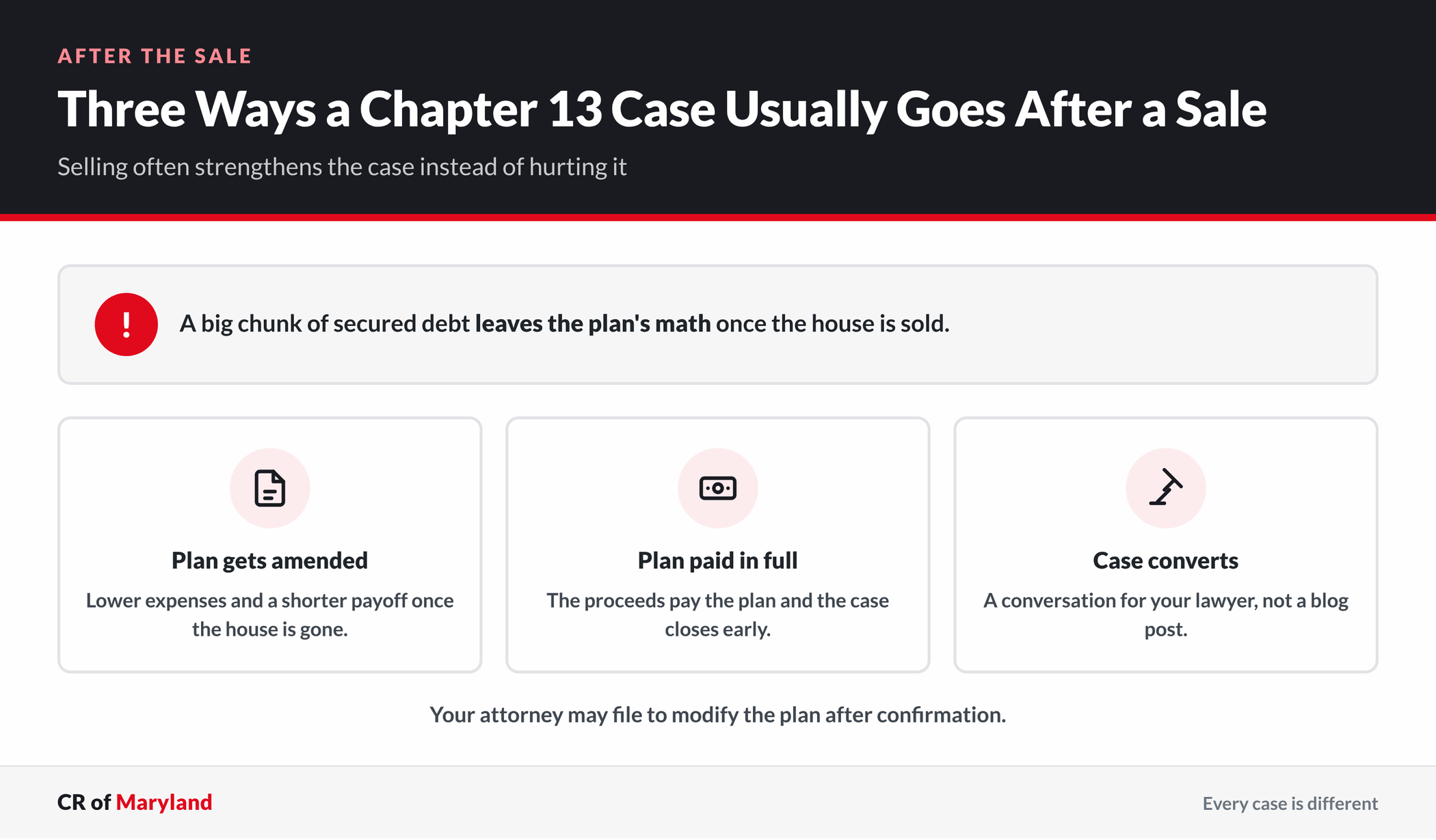
Usually it helps more than it hurts. Selling often strengthens a Chapter 13 case, because a big chunk of secured debt drops out of the plan’s math.
Plans can change mid-case. Once the house is sold, your attorney may file to modify the plan after confirmation, since the budget looks different. In other cases the trustee or creditors consent to the sale as part of a revised plan.
Three outcomes come up most often when a Maryland Chapter 13 case includes a sale, and I’ve watched all three play out. The plan gets amended to reflect lower expenses and a shorter payoff. Other times, the proceeds pay the plan in full and the case closes early. Or the case converts, which is a conversation for your lawyer and not a blog post.
In Anne Arundel County, the median home went under contract in 18 days in October 2026. You’d know within two or three weeks whether your price was right. Quick feedback like that is a gift when a trustee is waiting on you.
Should I Talk to My Maryland Chapter 13 Attorney Before Selling?
Yes, before you sign anything. Chapter 13 is a federal court case with your name on the caption. The motion to sell has to be drafted, filed and served correctly. It gets filed with the U.S. Bankruptcy Court for the District of Maryland. Once approved, the sale closes through a standard Maryland title company. Both the motion and the contract can move in parallel, so closing happens after the order is entered.
Filing Chapter 13 costs $313 in one-time court fees if you’re starting from scratch. That’s a $235 filing fee plus the $78 administrative fee listed on the current uscourts.gov schedule. Most Maryland bankruptcy attorneys fold their own fees into the plan payments instead of asking for cash up front. So a conversation about selling rarely triggers a new bill.
I’d push back on one piece of common advice: waiting until the plan finishes before you sell. For a homeowner whose income dropped, that can mean three more years of payments on a house they already know they’re losing.
A man called from Frederick on a Tuesday afternoon with a job transfer and five weeks to be out. He wasn’t sure the court would even allow it. His basement still had a half-finished bathroom from a project that stalled in 2019. We got his attorney on the phone that same week, and the contract went in subject to the court’s order.
Frequently Asked Questions About Chapter 13 and Maryland Home Sales
The question I hear first is what happens if you close without the court’s order in hand. In that case the sale can be undone, your case can be dismissed, and the protection you filed for disappears.
Can I Keep Living in the House While the Motion to Sell Is Pending?
Yes. Filing Chapter 13 doesn’t move you out, and you keep possession of the house until closing. Keep making your plan payments, plus any mortgage payments your plan says you pay directly. Falling behind while the motion is pending gives your lender a reason to ask for relief from the stay. Plan your move-out date around closing, since that can only happen after the court enters its order.
What If I Get an Offer Before the Court Approves the Sale?
Sign it, as long as the contract says the sale is subject to bankruptcy court approval. Your attorney attaches the contract to the motion to sell. Creditors and the trustee then get their window to object. Set the closing date far enough out to cover that window, which typically runs 30 to 60 days. Closing before the order is entered can undo the sale, so don’t let anyone rush that date.
What Happens If My House Sells for Less Than I Owe?
Your lender has to agree to take less than the full payoff, so expect a short sale review on top of the court process. Maryland’s local bankruptcy rules add a step here too. When the secured claims won’t be paid in full at closing, you file a notice setting a deadline for lienholders to file or amend their claims. That deadline must fall at least 21 days after closing. Ask your attorney how any leftover balance gets handled under your plan.
How Soon After My Bankruptcy Discharge Can I Sell My House?
Once your case is discharged and closed, the bankruptcy no longer sits between you and a buyer. You can sell without a motion or the trustee’s review, unlike the approval process described above for an open case. Title companies may still ask for a copy of your discharge paperwork at settlement, so keep it somewhere you can find it.
Can I Sell to a Cash Buyer While My Chapter 13 Case Is Open?
You can, and plenty of Maryland homeowners do, as long as the sale contract is made subject to the bankruptcy court’s approval. A cash buyer has an edge here, and it isn’t speed at the closing table. There’s simply no loan underwriting to collapse during the objection window, and your attorney can attach proof of funds to the motion.
Will Selling My House in Chapter 13 Wreck My Credit Further?
Finishing a sale that pays off your secured debt generally helps more than it hurts, because a mortgage paid off at closing stops piling up new late payments. Your filing already sits on your credit report, and a foreclosure landing on top of it is the worse outcome. Rebuilding starts sooner once the house is resolved.
Selling a Chapter 13 House Around Baltimore
Buyers around Baltimore have slowed down this fall. Bright MLS put the Baltimore metro’s Home Demand Index at 81 in October 2026, a reading it calls slow. That’s down from 85 in September and 91 a year earlier. Slower demand makes a court approval window feel longer, so price and timing both matter more.
We buy houses in Baltimore City and the surrounding counties, and we’re active cash home buyers in Towson too. You can see how our process works when a bankruptcy case is open. You’ll get a written offer your attorney can attach to the motion to sell. We’ll work around the court’s schedule instead of pushing against it.
Talk With CR of Maryland About Your Chapter 13 Sale
If your house has become the hardest part of your Chapter 13 plan, we’ll look at the numbers with you and your attorney. Contact CR of Maryland or fill out the short form below, and we’ll reach out to talk it through.
If the house has turned into the problem instead of the thing you were protecting, I’m happy to walk through what a sale would look like for you. I’ll also cover what your attorney and the trustee will need from a buyer. We’re CR of Maryland, and we’ve closed these alongside bankruptcy counsel instead of working around them. No pressure and no obligation. If the right answer is to stay and finish your plan, I’ll tell you that too.