
Your mortgage doesn’t just cover the land. It covers the structure sitting on it, and in most loan documents those two things are treated as one piece of collateral. Knock the structure down without telling your lender, and you’ve handed them a reason to call the whole loan. People who assume a tear down is just a permit and a bulldozer are surprised by that piece.
I’ve bought a lot of houses that were worth less than the dirt under them. Sellers ask me this question constantly.
Can You Tear Down a House with a Mortgage?
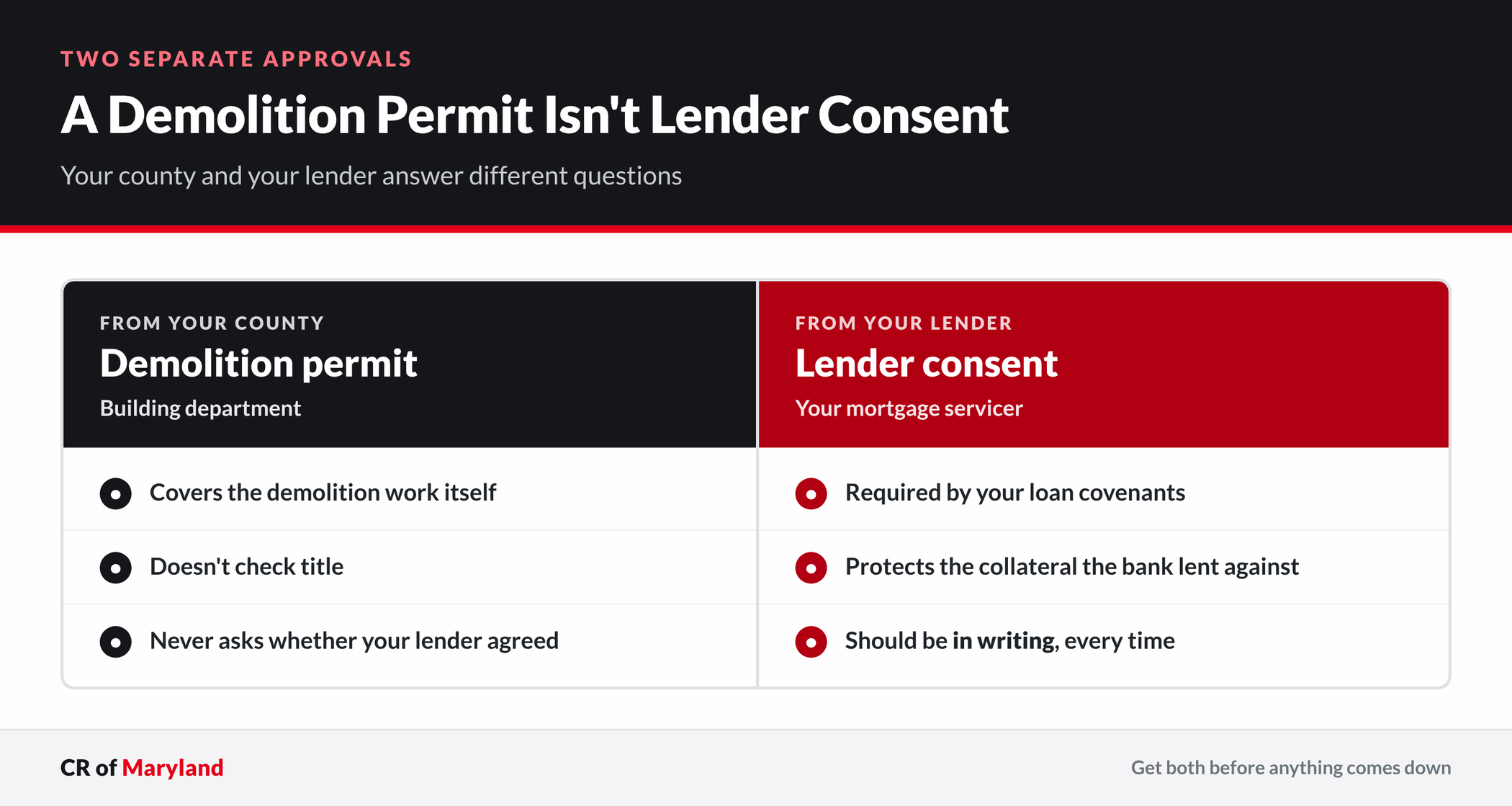
Demolition permits and lender consent are two completely separate approvals, and your county will happily issue the first without ever asking about the second. Building departments don’t check title. Homeowners get a permit in hand, feel cleared to proceed, and only later find out they’ve broken a loan covenant. One demolition contractor’s guidance on mortgaged properties puts it plainly: lender consent is a loan requirement, not a city permit requirement.
So yes, a tear down is legally possible with a mortgage on the property. It just can’t be a surprise to the bank.
A few years back I worked with a young couple outside Boise, Idaho who’d been quietly carrying two mortgage payments for almost a year. They’d bought a newer place after the first house flooded. The old one sat there with a gutted kitchen and a detached garage full of salvaged cabinets nobody wanted. Their plan was a demolition and a rebuild. Nobody had told their lender a word about it.
What saved them was asking before the equipment arrived. The conversation went fine. It usually does when you’re the one who starts it.
Most standard loan documents include language requiring the borrower to maintain the property and not permit waste or destruction. Demolition falls squarely inside that language. Whether your particular lender treats a planned demolition as a violation or as a project to finance depends almost entirely on what you propose to put back.
Will Tearing Down a House Violate Your Mortgage Agreement?
Can the bank really take my house over a bulldozer?
They can call the loan, which amounts to the same thing if you can’t pay the balance that day. Acceleration clauses give lenders the option to demand the entire remaining balance when certain covenants break. Wiping out their collateral qualifies. One law firm’s write-up on due-on-sale acceleration notes that a lender can refuse your payments and declare the full balance due, even when you’re still current.
Think about what a mortgage really is. The bank didn’t lend you money because they liked you. They lent against something they could sell if you stopped paying. A vacant lot sells for a fraction of what an improved parcel brings, so an unauthorized tear down converts strong collateral into weak collateral overnight.
You’ll need to loop your insurance company in too. Most homeowners policies cover a dwelling, and the moment the dwelling is gone, so is that coverage. Lenders require continuous hazard insurance as a condition of the loan. An unpermitted tear down can therefore break two covenants at once: the one about waste, and the one about keeping the property insured.
I’ll disagree with advice I see online constantly. People claim lenders never notice. They do notice. Tax assessors update records, insurance carriers cancel policies on nonexistent structures, and servicers run property inspections on files they’re watching. Someone will eventually find out.
Does that mean a tear down is off the table? Not at all. It means the sequence matters more than the project.
What Does Your Mortgage Lender Say About Tearing Down a House?
Construction loan rates were running roughly one to two percentage points above conventional rates in 2026. The 30-year fixed sat at 6.76% in mid-September, according to a lender guide published by AmeriSave. That gap shows how a bank sees a tear down: as added risk that needs to be priced in.
Lenders you talk to will generally land in one of three places. Some will refinance you into a construction product that pays off the old loan and funds the demolition plus the rebuild. Others will approve the work with conditions attached, like escrowed funds or contractor documentation. And a few will tell you the structure stays until the loan is paid in full.
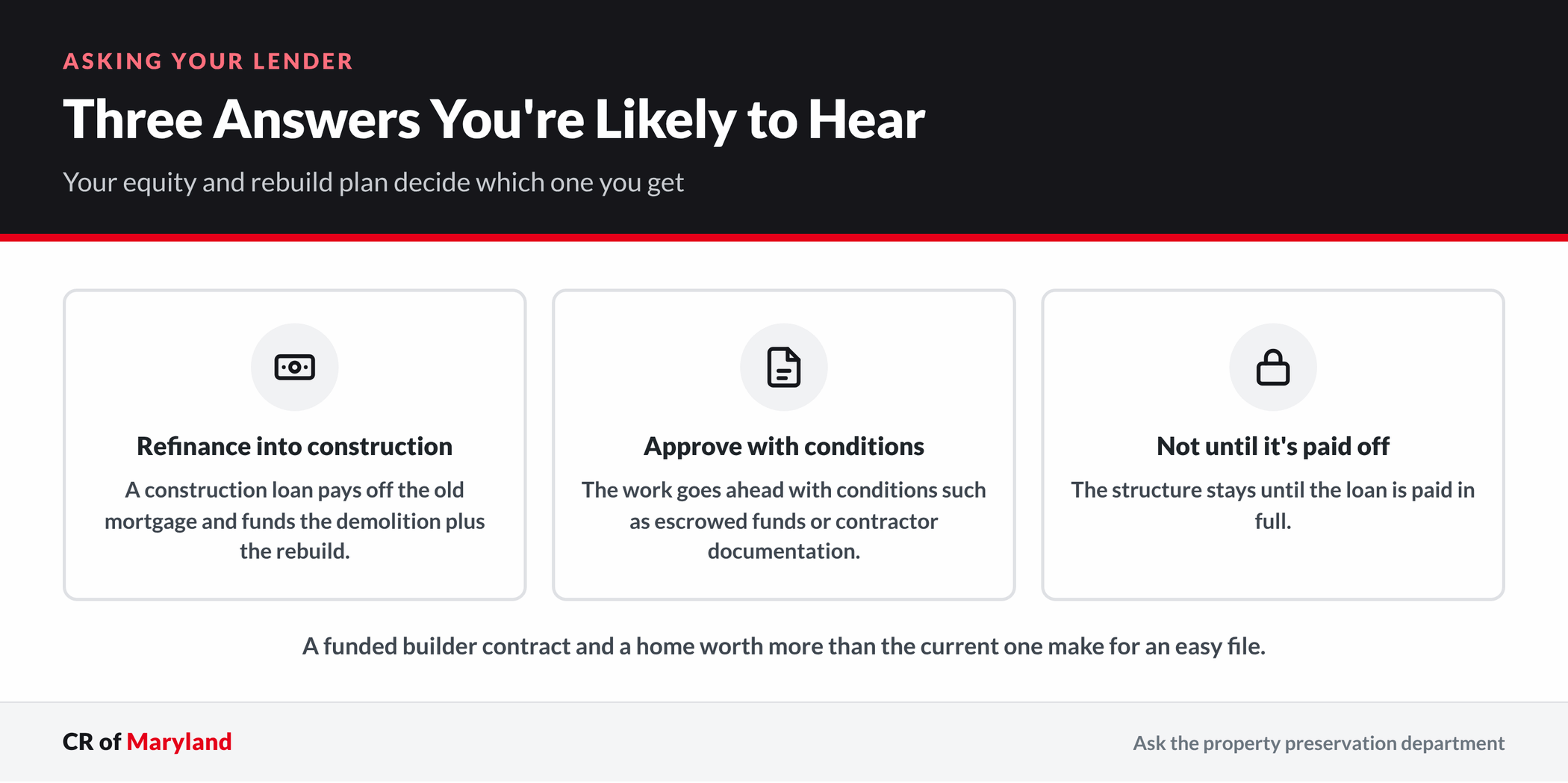
The last response is real. One builder resource describes the worst case bluntly: your lender may require you to own the property outright before any demolition happens.
Equity and a solid rebuild plan are the strongest predictors of which answer you get. A borrower with a funded builder contract and a replacement home worth more than the current one presents an easy file. Someone with thin equity and a vague intention to “clear the lot and figure it out” presents a problem.
Ask your servicer for the loss payee and property preservation department, not the general customer line. The first-tier representative answering the phone has no authority over collateral decisions and will often guess. I’ve watched sellers get a cheerful verbal yes from someone who had no idea what they’d approved.
Get it in writing. Every time.
How Do You Get Lender Approval Before a Tear Down?
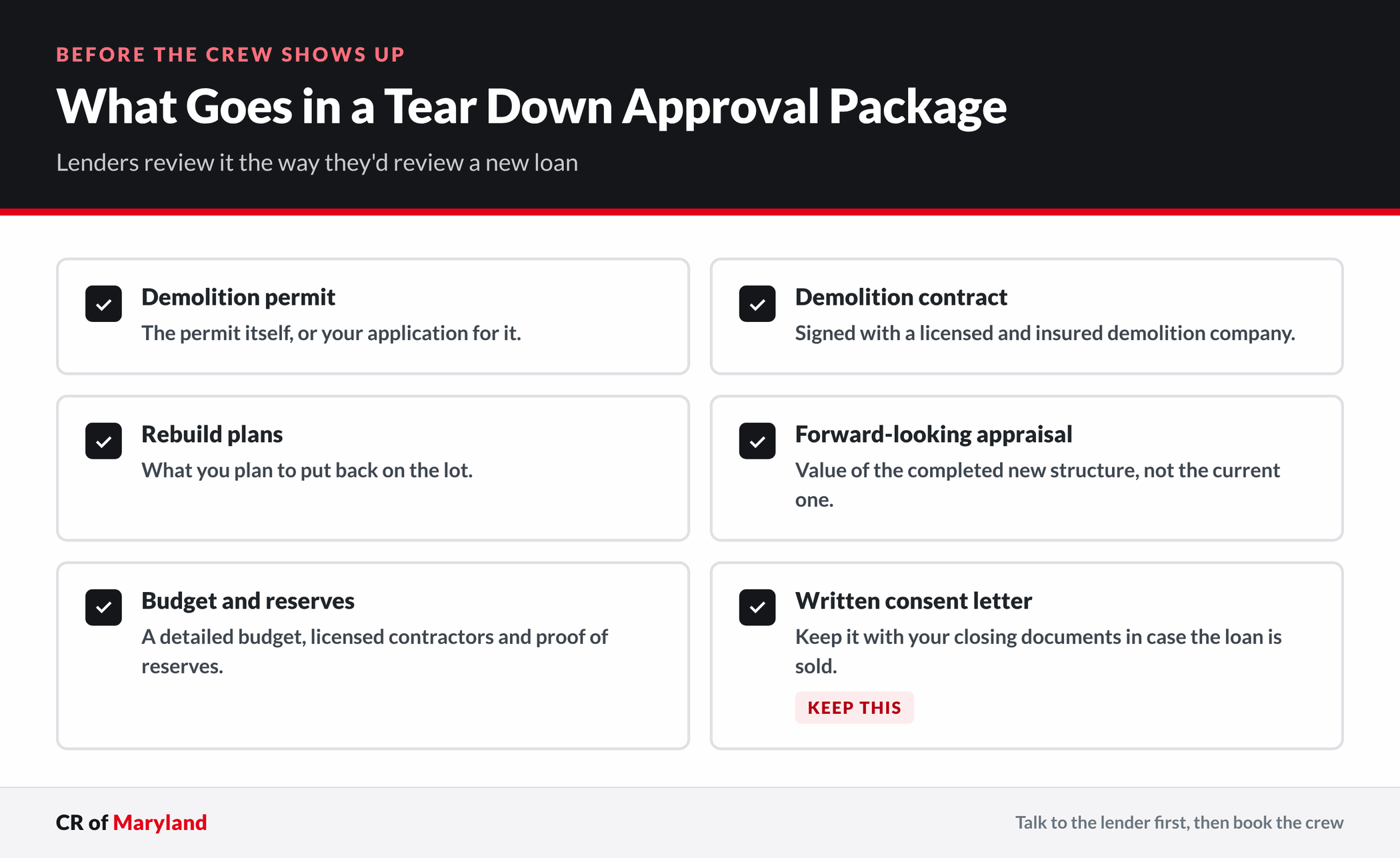
Which brings up the practical question of what to put in front of them. A request for tear down approval isn’t a phone call, it’s a package. Lenders evaluate it the way they’d evaluate a new loan, because functionally that’s what you’re asking for.
Include your demolition permit or the application, a signed contract with a licensed and insured demolition company, your rebuild plans, and an appraisal of the completed new structure rather than the current one. That forward-looking appraisal matters enormously. It reframes the conversation from “you’re destroying my collateral” to “you’re upgrading it.”
Timing runs longer than people plan for. Construction underwriting is stricter than standard mortgage underwriting, and lenders want a detailed budget, licensed contractors, and proof of reserves before releasing anything.
Many homeowners line up a demolition crew with a firm start date, then start the lender conversation. Reverse that order. The crew can wait; a called loan can’t.
Expect your file to be reviewed against your current credit and income, not the profile you had when you originally borrowed. If your financial picture has softened since then, the tear down request may surface problems unrelated to the project itself. I’ve seen plenty of homeowners discover at this stage that a sale makes more sense than a rebuild. That’s a legitimate outcome, not a failure.
Build a written consent letter into your file before anything comes down. Keep it with your closing documents. Should your loan get sold to another servicer midstream, which happens constantly, that letter is the only proof you’ll have.
What Are the Risks of a Tear Down with an Existing Mortgage?
A seller called me about an inherited rancher with a cracked slab and an addition that had been framed without permits. He’d already had half the roof removed when his insurance carrier dropped the policy. His servicer sent a letter within the month.
Force-placed insurance is one of the quieter risks. When your coverage lapses, servicers buy their own policy and bill you for it, typically at a much higher cost than what you were paying. A partially demolished structure is nearly impossible to insure on the open market, so you’re stuck with whatever the servicer picks for you.
Then there’s the appraisal gap during construction. A cleared lot appraises below the mortgage balance in plenty of markets, especially where the house carried most of the value. With the national median sale price at $388,634 in October 2026 per Redfin’s market data, a typical lot in an average market is a modest share of that figure. You could sit underwater for months through no fault of your own.
Sellers face headaches when permits expire mid-project or contractors file liens against a property that no longer has a building on it. Neither of those gets easier because you have a mortgage, but both get more expensive.
Market timing deserves a mention. The median home nationally took 50 days to sell in October 2026, and that same report showed prices down about 0.4% year over year. A rebuild that stretches eighteen months lands in a market nobody can forecast today.
I’d weigh the personal risk heaviest, though. Carrying a mortgage on an empty lot while paying rent somewhere else drains people in a way spreadsheets don’t capture. Can you comfortably fund both for longer than you planned? If the honest answer is no, a tear down financed on optimism is a bad bet.
What Happens to Your Mortgage After a Tear Down?
Get the financing structure wrong and you end up making payments on a loan secured by nothing but dirt. There is no path to a new house. No buyer will take the lot at a price that clears your balance. This is the failure mode, and it’s avoidable.
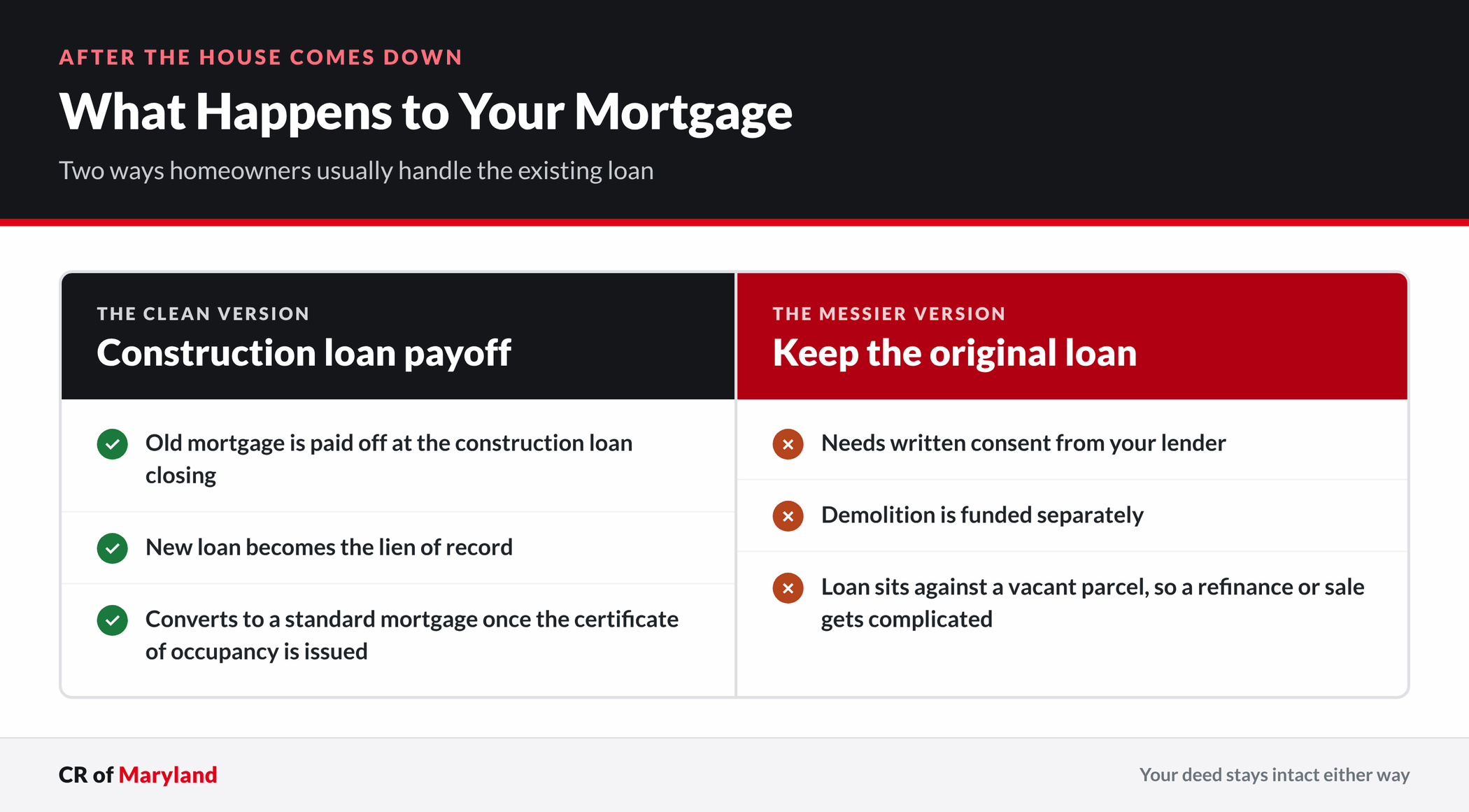
In the clean version, the old loan doesn’t survive the tear down at all. The existing mortgage is paid off at the construction loan closing, and the new loan takes its place as the lien of record. One lender in CNBC’s 2026 roundup of construction lenders advertises exactly this: paying off your existing loan before construction starts.
Single-close construction-to-permanent loans then convert into a standard amortizing mortgage once the certificate of occupancy is issued, handled through a rider or modification rather than a second closing. You pay interest only on drawn funds during the build, so your payment climbs in stages as the house goes up.
The messier version is keeping your original mortgage in place with written consent and funding demolition separately. That works, but your loan now sits against a vacant parcel. Any refinance or sale before the rebuild finishes gets complicated.
Title shifts too. The legal description references the parcel, not the house, so your deed stays intact. Property tax assessments change, though, and your county will reclassify the parcel after the structure comes off the rolls. Timing varies by jurisdiction, and the local assessor’s office can tell you when the change hits your bill.
Homeowners occasionally use loan modifications when they can’t qualify for new construction financing. Servicers have limited appetite for modifying a loan on land, so don’t count on it as a backup plan.
Can You Get a New Mortgage After a Tear Down?
“No bank will lend on a project like this.” I hear that a lot, and it’s wrong. Construction lending is an established product with defined underwriting, not a favor you talk someone into.
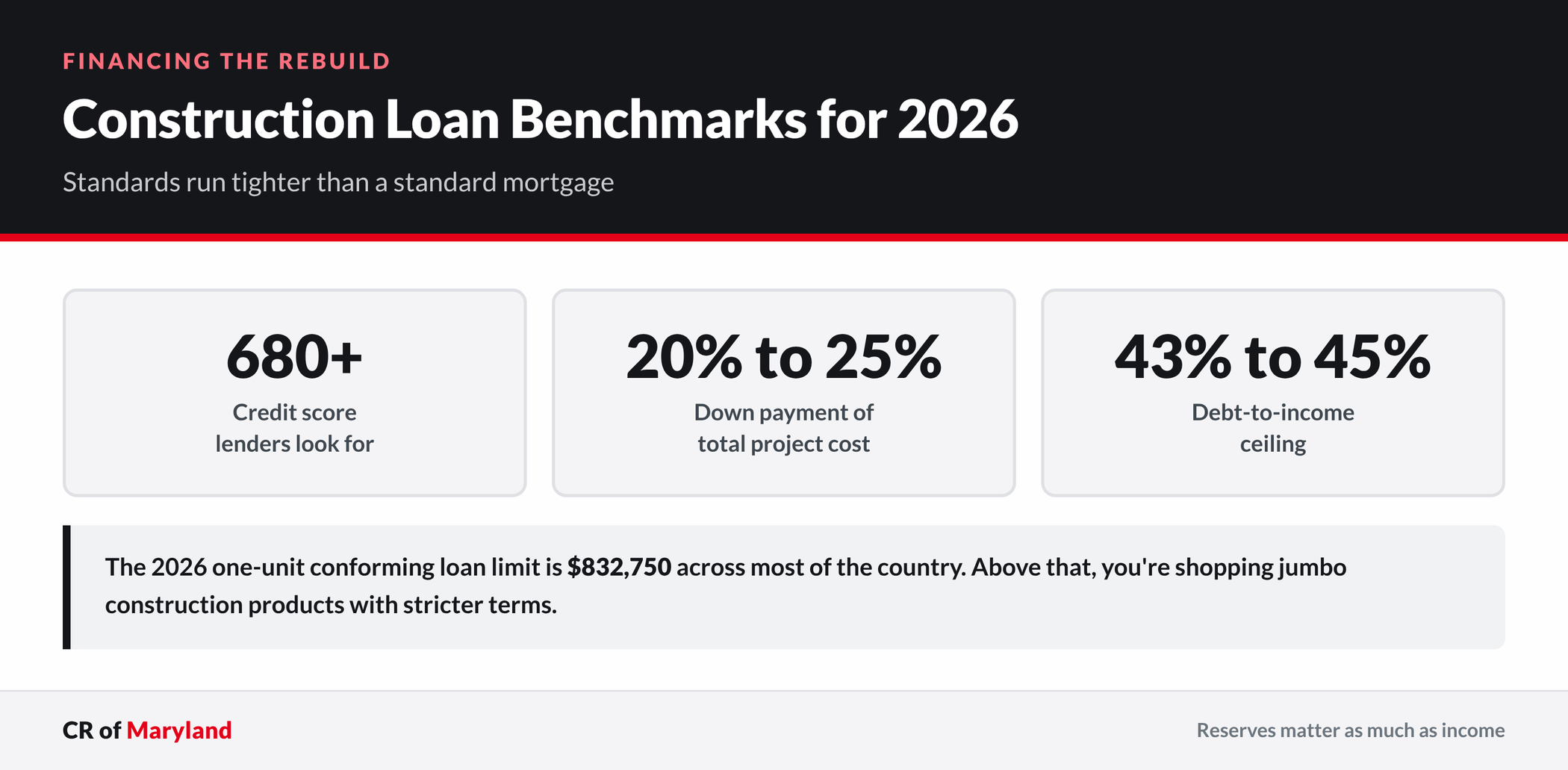
Qualification standards do run tighter. Industry guidance for 2026 points to credit scores of 700 or better and down payments of 20% to 25% of total project cost. Debt-to-income ratios get capped near 43% to 45%, per this construction loan guide. Reserves matter as much as income.
Conforming limits apply to the permanent phase. FHFA set the 2026 one-unit conforming loan limit at $832,750 across most of the country, reported in this breakdown of construction-to-permanent lending. Go above that and you’re shopping jumbo construction products with stricter terms.
What about homeowners who’ve already completed a tear down and now own bare land? It’s harder to finance, but not impossible. Land loans exist, though rates run higher and down payment requirements climb. Lenders price the risk of an empty parcel accordingly.
My read, after watching many of these play out: if your credit or income has slipped, forcing a tear down and rebuild through financing turns into a long, expensive stall. Selling the property as it stands and starting fresh is often the better financial decision, even when it feels like giving up on a plan. I’ve seen homeowners regret dragging out the fight longer than they needed to. Teams like CR of Maryland buy properties in exactly this condition, which gives homeowners a real alternative to grinding through construction underwriting.
Who Can Help with a Tear Down and Mortgage Questions?
A woman in Dubuque, Iowa reached out about her late father’s bungalow, foundation failing on one corner, the garage still holding his woodworking bench and about forty coffee cans of hardware. Her mother had just moved into assisted living two states away. She was driving back and forth on weekends trying to decide between a tear down and a sale.
Build a small team before you commit to anything. A real estate attorney reads your actual mortgage, not a generic template, and tells you precisely which covenants a tear down would trip. That review typically costs a few hundred dollars and is the best money in this entire process.
The servicer’s property preservation group gives you the lender’s position. A construction lender tells you whether the rebuild math works. And an experienced local investor tells you what the property is worth right now, as-is, which is the number most homeowners are missing when they start weighing options.
I’d add one more: a demolition contractor who’ll walk the site before you sign anything. Asbestos abatement, utility disconnects, and permit fees can reshape a budget fast, and that walkthrough is usually free.
For homeowners who decide the tear down isn’t worth it, selling directly avoids the whole approval chain. CR of Maryland has bought plenty of houses where demolition was on the table, and the mortgage simply gets paid off at settlement like any other sale.
Frequently Asked Questions About a Tear Down with a Mortgage
How Much Would I Pay Each Month on a Million-Dollar Construction Mortgage?
It depends on rate and term. A million-dollar balance on a 30-year fixed at current rates lands somewhere around six to seven thousand dollars a month in principal and interest alone. Taxes, insurance, and any HOA dues stack on top of that. If a rebuild would push you into that range, run the full payment before you commit to a tear down, not after.
What Income Do You Need to Qualify for a $400,000 Construction Mortgage?
Most lenders want your total housing payment plus other debts to stay under the debt-to-income ceiling described earlier in the article. For a loan that size, that usually translates to household income somewhere around $100,000 to $125,000, depending on your other obligations, your down payment, and local property tax rates. A borrower with no car loan and no student debt qualifies at a lower income than one carrying both.
Can You Get Out of a Mortgage Early If a Tear Down Stalls?
You can, though the mechanism matters. Paying the loan off through a sale or refinance ends it cleanly, and most modern residential loans don’t carry prepayment penalties. Walking away from payments is a different thing and damages your credit for years. If the project has stalled and the payment has become unmanageable, selling the property is almost always the better exit.
Does the 3/7/3 Rule in Mortgage Lending Cover Construction Financing?
It does, and it’s shorthand for federal disclosure timing. Your lender must get you a Loan Estimate within three business days of your application, and closing can’t happen until seven business days after that estimate goes out. You must also have the Closing Disclosure in hand at least three business days before you sign. The CFPB lays out the waiting period rules in its TILA-RESPA disclosure FAQs, and they apply when you finance a tear down and rebuild.
Does a Tear Down Hurt My Credit?
Not by itself. Demolition isn’t reported to credit bureaus. What can hurt your credit is the chain of events that follows an unauthorized tear down: a called loan, missed payments on a balance you can’t cover, or a foreclosure filing. Keep the lender informed and the project never touches your credit report.
If you’re sitting on a property where a tear down is one of the options and you’re not sure the numbers work, we’re glad to talk it through. No pressure, no obligation, and no hard sell if selling turns out to be the wrong move for you.
Thinking About a Tear Down in Maryland?
Buyers statewide pulled back this fall, which makes a long rebuild harder to time. New contracts in Maryland fell 19% in October 2026 compared with a year earlier, according to Maryland REALTORS. Fewer buyers can stretch the months you’d carry a mortgage on an empty lot.
If the rebuild math doesn’t hold up, a direct sale skips the lender approval chain. We buy houses in Baltimore as-is, including ones where demolition was already on the table.
Owners elsewhere in the state have the same option. Homeowners across Maryland can sell without clearing the lot, hiring a builder or waiting on a construction loan.
Talk With CR of Maryland About Your Tear Down Options
Your loan documents and your lot decide what’s possible, and a short conversation can sort that out. Reach out to CR of Maryland and tell us about the house and what you’d planned to build. You can also fill out the form below, and we’ll follow up with a fair cash offer you’re free to turn down.