
A paused mortgage payment feels like oxygen for about four months. Then the paperwork shows up, the servicer asks how you plan to catch up, and the arithmetic stops being friendly. If you’re a Maryland homeowner sitting in mortgage forbearance and wondering whether selling is even allowed, the short answer is yes. You don’t need your lender’s permission to list. What you do need is a clear picture of what you owe, what your property is worth, and how fast the two can meet.
I’ve bought Maryland houses from sellers at every stage of mortgage trouble. Forbearance is one of the better spots to be standing in, because you still hold the steering wheel.
What Is Mortgage Forbearance and How Does It Work?
Three siblings in Dundalk, Maryland called me one winter about their late father’s house, a rancher with a sagging carport nobody wanted to fix. They’d gotten mortgage forbearance on his loan during the estate paperwork, and the pause was ending that spring. We closed before the first catch-up payment came due, and the payoff cleared the forborne balance at the settlement table.
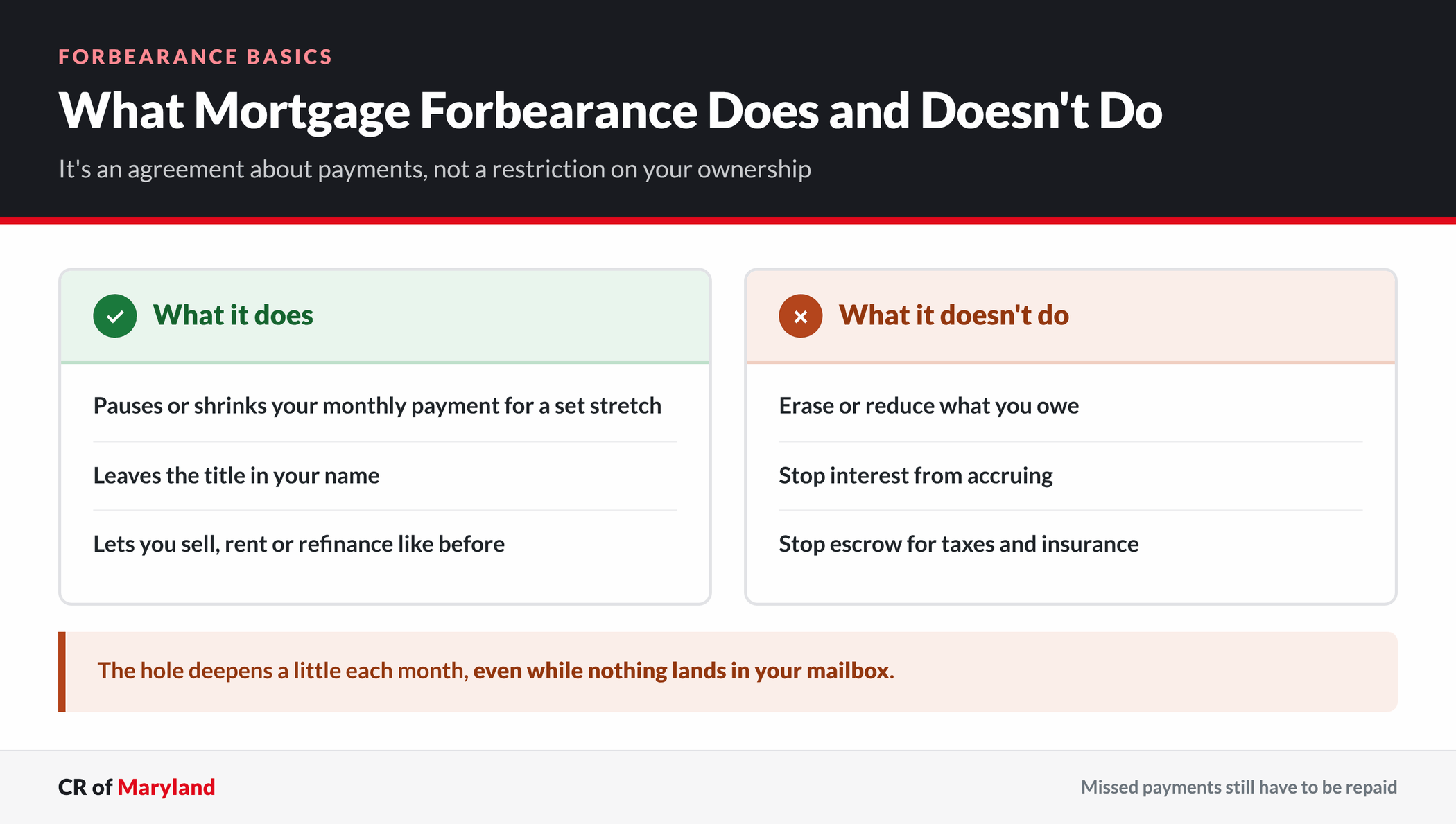
Mortgage forbearance is a temporary arrangement where your servicer agrees to pause or shrink your monthly payments for a set stretch of time. It doesn’t erase or reduce what you owe, so you’ll have to repay the missed or reduced payments later. People lose that last part in the relief of a phone call that goes well.
On paper, the servicer simply stops demanding the regular payment. Interest keeps accruing on the balance, and escrow for taxes and insurance usually keeps running too, which means the hole deepens a little each month even though no bill lands in your mailbox.
Forbearance agreements come in flavors. Some pause payments entirely; others cut them in half for six months. A lump-sum repayment at the end typically isn’t the only option on the table, despite what homeowners fear when they first call in.
Does the house itself change hands or status during any of this? No, it doesn’t. Title stays yours, the lien stays where it was, and you can sell, rent, refinance, or hand the keys to a buyer exactly as you could before. Mortgage forbearance is an agreement about payments, not a restriction on your ownership.
Does Your Loan Type Change How You Sell During Forbearance?
Your loan type won’t stop a sale. It does shape the payoff figure you’ll see and how much time you really have.
Borrowers with federally backed loans have always had the clearest options. Fannie Mae, Freddie Mac, FHA, VA, and USDA loans each run their own hardship programs, and the agencies change those rules now and then. CARES Act relief only ever covered those loans, and that pandemic program is over. Only your servicer can tell you which bucket your loan sits in today.
Private lenders, portfolio lenders and local Maryland credit unions set their own terms, full stop. Some want the full forborne amount the day the pause ends. If that’s your loan, a sale that closes before the end date keeps that lump-sum demand from ever landing.
The closing works the same either way. The forborne balance rides inside your payoff figure, and the title company clears the loan at closing whether Fannie Mae or a credit union holds it.
Whatever put you in forbearance, from job loss or medical bills to divorce or a death in the family, the sale runs the same way. Your equity decides how much you walk away with.
Before you list, know your loan type, know your arrears balance, and ask your servicer how it handles a payoff during the plan. Get that answer in writing.
If your hardship looks permanent, call Maryland HOPE, the state’s free homeowner hotline, before you sign anything new. A sale you plan early leaves you more room than one you rush.
How Long Does Mortgage Forbearance Last for Maryland Homeowners?
Sit across a kitchen table from me and I’ll tell you the same thing I tell everyone: assume you have less runway than your servicer implied. Plans get described in months, but extensions depend on investor approval, program status, and on whether your documentation came in on time.
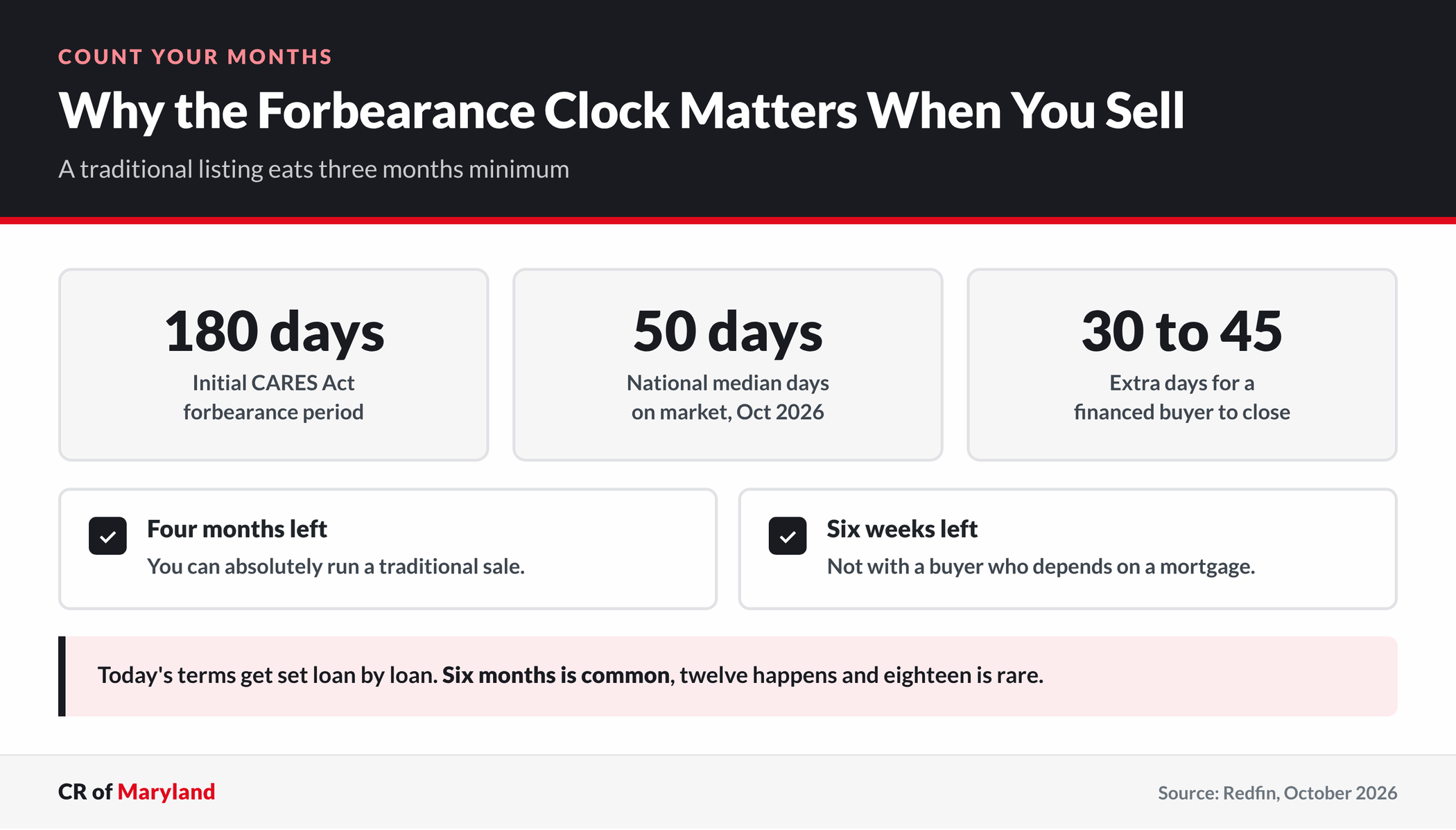
The CARES Act set an initial forbearance period of up to 180 days for borrowers who requested it and attested to COVID-related hardship. An extension was available for a second six months. However, pandemic-era programs have been winding down for years now. The Mortgage Bankers Association (MBA) has pointed to the expiration of pandemic-era FHA relief options at the end of September 2025 as one driver of changing delinquency patterns, which tells you how much the ground has shifted.
Today’s mortgage forbearance terms get set loan by loan. Six months is common. Twelve happens. Going past a year usually takes the investor’s sign-off.
Maryland sellers should watch the clock closely, because listings don’t move overnight. Redfin’s early November 2026 report had the typical U.S. home spending 50 days on the market before going under contract. Add roughly a month to six weeks for a financed buyer to close, and a traditional listing eats close to three months from the day the sign goes in the yard.
A Maryland homeowner with four months left in mortgage forbearance can absolutely run a traditional sale. Someone with six weeks left cannot, not with a mortgage-dependent buyer. That’s the fork in the road where a direct cash sale starts making sense. It’s also why I ask sellers to count their remaining months before they interview a single agent. We close on timelines measured in days rather than months, which changes what’s possible when the calendar is tight.
Can You Sell Your Maryland House While in Mortgage Forbearance?
Maryland landlords call me about this as often as owner-occupants do, usually with a worn-out rental and a pause that’s half used up. The forbearance itself almost never slows those sales. Repairs and second thoughts eat most of the calendar.
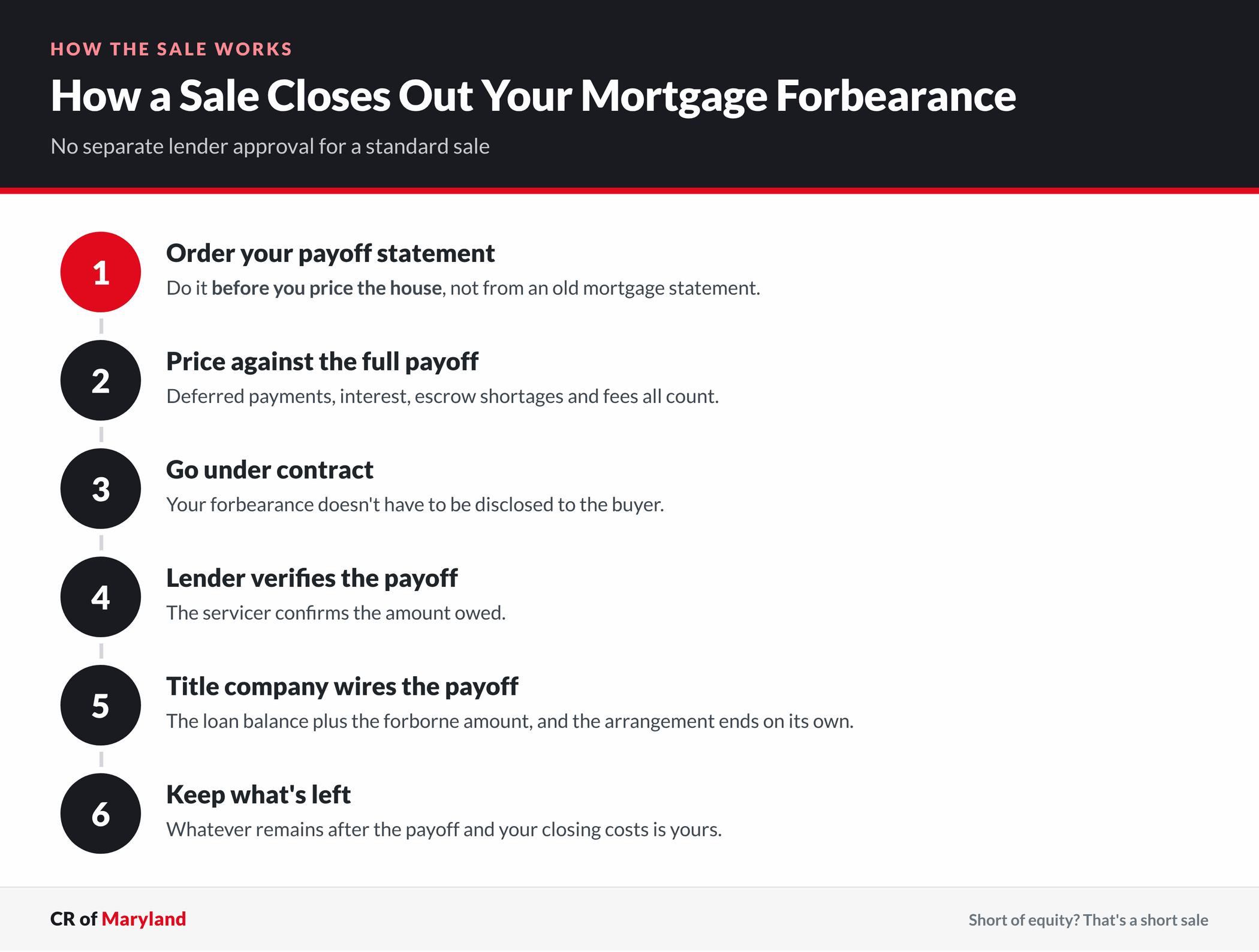
Selling a Maryland house during mortgage forbearance is permitted. There are no lender restrictions on selling a home with a mortgage in forbearance. Nor does a standard sale need separate lender approval. Your servicer issues a payoff statement, the title company wires the loan balance plus the forborne amount at closing, and the arrangement ends on its own.
The mechanics are simpler than they look. Your sale has to generate enough to cover everything owed on the loan, including deferred payments, interest, escrow shortages, and fees that built up during the pause. Once you’re under contract, the lender verifies the payoff amount. Whatever’s left after that and your closing costs is yours.
Equity is the whole ballgame. Have it, and selling during mortgage forbearance is a clean exit that protects your credit and your next housing move. Lack it, and you’re looking at a short sale, which does require lender sign-off and does take longer.
Order your payoff statement before you price the house. I’ve watched sellers list based on a mortgage balance they pulled from an old statement, then discover at closing that escrow advances and accrued interest ate the equity they’d already spent on paper.
Thin equity changes the math, not the permission. A buyer who closes in days can keep the forbearance arrears from growing by another payment or two.
What Happens to Missed Payments After Mortgage Forbearance Ends?
Escrow shortfalls usually surprise people more than the skipped principal and interest. During the pause, the servicer kept paying your Maryland property taxes and homeowners insurance even though you weren’t paying anything. Those advances get added to what you owe, often spread across your next twelve monthly payments on top of everything else.
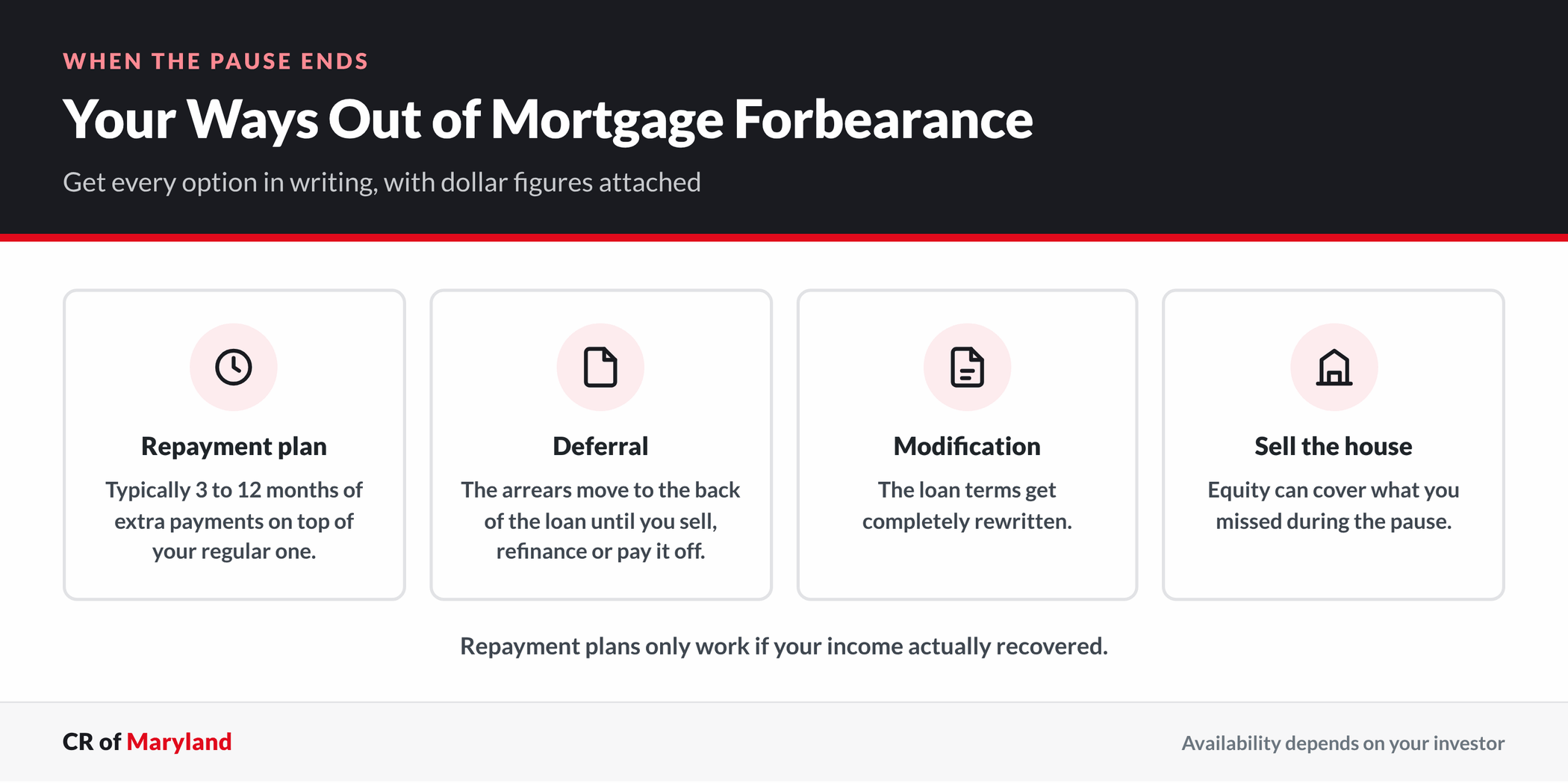
The exit paths come down to a handful. A repayment plan spreads the missed amount across a set stretch, typically 3 to 12 months of extra payments stacked on your regular one. Deferral moves the balance to the back of the loan, where it sits until you sell, refinance, or pay the mortgage off. Modification rewrites the loan terms completely.
Deferral is the quiet favorite, and it deserves more attention than it gets. Monthly payments go back to normal, the arrears ride along as a non-interest-bearing balloon, and nothing changes month to month. Availability depends on your investor, so ask by name.
If your initial forbearance came under the CARES Act, your servicer can’t require you to repay everything at once. Non-federally backed loans don’t carry that protection, and some private lenders do want the full amount when the term expires.
Here’s where selling enters the picture for a lot of Maryland homeowners. Repayment plans only work if your income actually recovered. A seller whose hours never came back is signing up to fail twice: once on the mortgage forbearance, once on the repayment plan that followed. Equity gives you a third option, and plenty of my sellers have leaned on it, since the proceeds can cover what you missed during the pause.
Get every exit option in writing, with dollar figures attached, before you choose.
Does Mortgage Forbearance Hurt Your Credit Score?
One mistake here means years of explaining a 90-day late mark to every underwriter you meet. A 90-day late is reported and materially damages credit, which is exactly what happens to homeowners who stop paying without an agreement in place.
An agreement used to lock in better reporting. Section 4021 of the CARES Act changed the Fair Credit Reporting Act for pandemic accommodations. Lenders had to report you as current if you were current going in and kept to the plan’s terms. The rule only covered the pandemic period and has since lapsed, so ask your servicer in writing how it will report you during the plan.
Following the plan to the letter matters even more now. Inconsistent partial payments can sit unapplied in a suspense account and muddy the credit reporting on your account. Pay exactly what the agreement says, or pay nothing if it says nothing. Improvising is where protection breaks.
Mortgage lenders see more than your score. A forbearance notation on your credit report is visible to any underwriter reviewing future loan applications, and many require a seasoning period after a mortgage forbearance before approving a new home loan. Your score may look fine, but your file still raises questions.
Does that mean you should avoid forbearance to protect your credit? No. A servicer generally can’t start a foreclosure while you’re keeping to a forbearance plan, and a Maryland foreclosure damages credit far longer than a late payment does. Choosing between a documented pause and silent nonpayment isn’t a close call.
Maryland sellers who close while they’re still keeping to the plan’s terms keep late marks off that record. That’s the piece worth planning around.
What Are the Downsides of Mortgage Forbearance?
For a long time I treated a paused payment as neutral, and I was wrong about that. It’s a loan against your future cash flow, and the bill arrives whether or not your situation improved.
Interest accrual is the first cost. Missed payments keep accruing finance charges during mortgage forbearance, which adds to the overall cost of the mortgage loan. Six months of paused payments on a typical loan leaves a four- or five-figure hole, and that hole doesn’t shrink on its own.
The second cost is optionality. Refinancing during or shortly after mortgage forbearance ranges from difficult to impossible depending on your loan type, and home equity borrowing dries up in the same stretch. You’ve traded flexibility for breathing room.
Market risk is the one that stings. Maryland REALTORS reported average and median sales prices falling together in October 2026, and the number of homes for sale kept climbing. A Maryland homeowner who waits out a long forbearance in a softening market can lose equity at the same time arrears accumulate.
Then there’s the emotional cost, which nobody prices. Living with a growing debt and a deadline you can’t control wears people down.
Mortgage forbearance also doesn’t fix what caused the hardship. MBA’s National Delinquency Survey put the national delinquency rate on one-to-four-unit residential mortgages at 4.37% at the end of the second quarter of 2026. Plenty of those borrowers cycled through relief that bought time without solving anything.
Is Mortgage Forbearance the Right Choice for You in Maryland?
The pitch sounds like a bridge: pause payments, recover income, resume where you left off. That works when the hardship has a visible end date, a return-to-work letter, a settlement check, a new job starting in eight weeks. It falls apart when the income loss is structural, since mortgage forbearance just relocates the problem to a month when the payment is bigger.
Ask yourself one question. When the plan ends, can you cover your normal payment plus a catch-up amount on top of it?
If the answer is no, selling before you lose control of the process is the stronger play. Nationally, MBA put the share of loans in the foreclosure process at 0.67 percent at the end of the second quarter of 2026, up 19 basis points from a year earlier. Maryland law makes the servicer mail a Notice of Intent to Foreclose at least 45 days before filing in circuit court. Once that letter arrives, your options start narrowing by the week.
A landlord in Cumberland, Maryland reached me on a Tuesday with eleven months of missed payments behind him and an auction date already posted. His rental had been vacant eight months, the garage still held the previous tenant’s abandoned furniture, and he’d stopped opening servicer mail sometime in the spring. We closed before the sale date, he cleared the arrears, and he kept the small amount of equity he had left instead of watching it evaporate on the courthouse steps. Mortgage forbearance would have helped him a year earlier; by that Tuesday, it was too late to matter.
Timing decided that one. Homeowners who move early have four or five options; homeowners who wait have one. If you’re weighing whether to list traditionally or sell direct, CR of Maryland can walk you through both sets of numbers without pushing you toward either.
Frequently Asked Questions About Selling a Maryland House During Mortgage Forbearance
Will Selling End My Forbearance Agreement?
Yes. When the house closes, the title company wires your servicer the full payoff, and that figure already includes the forborne amount, interest that built up and any escrow the servicer paid. Almost every mortgage carries a due-on-sale clause, so the loan can’t stay behind after a standard sale. Once it’s paid off, the agreement has nothing left to cover. Ask for a written payoff statement so the number at the table matches your plan.
Will Being in Forbearance Slow Down or Complicate My Home Sale?
It shouldn’t. Your Maryland title company requests a payoff figure from the servicer the same way it would on any other transaction, and the forborne amount shows up as part of that number. Buyers never see it. The one real complication arrives if your arrears plus your closing costs exceed what the house is worth, since that turns an ordinary sale into a short sale requiring lender approval.
How Long Can a Mortgage Stay in Forbearance?
That depends on who owns your loan and what program you entered. Federal programs have historically run in six-month blocks with extensions available. Private lenders write their own terms, and some are far shorter. Call your servicer and ask for your exact end date in writing, then count backward from it when you plan a sale.
Do I Need My Servicer’s Permission to Sell?
Not for a standard sale. You can list, sign a contract and close without your lender’s sign-off, since the payoff at closing clears what you owe. Permission only matters when the sale won’t cover the full balance. That’s a short sale, and it needs lender approval and more time. It still helps to tell your servicer you’re selling, so the payoff statement comes back fast.
Do I Have to Tell My Buyer About the Forbearance?
No. The arrangement sits between you and your servicer, and it has no bearing on the property’s condition or title. Under Maryland law, the seller disclosure form covers the property’s condition, not your payment history.
Selling a House in Forbearance in Maryland
Maryland’s market cooled hard this fall. Home sales fell 16.5% in October 2026 compared with a year earlier, according to Bright MLS data compiled by Maryland REALTORS. Over the same stretch, the median sales price slipped 1.7% to $430,000. Fewer buyers means a traditional listing can outlast what’s left of your mortgage forbearance.
Settlement in Maryland runs through a title company or settlement attorney. That office orders your payoff, collects the state and county transfer and recordation taxes, and wires the lender its money. Your forbearance balance rides along in the payoff figure like any other amount owed, so Maryland sellers don’t need a separate step to clear it.
We buy houses for cash in Baltimore and nearby towns, and a direct sale can close on your schedule. That includes homeowners who want to sell a house fast in Dundalk and landlords looking for cash home buyers in Cumberland.
Sellers across the rest of Maryland get the same setup, with the payoff handled at the title company.
Talk With CR of Maryland About Selling During Forbearance
Bring your payoff statement and your mortgage forbearance end date, and we’ll walk through what a direct sale would look like for you. Contact CR of Maryland or fill out the short form below to get started.