
A gross estate of $50,001 changes your next twelve months. One dollar over the line puts you on a completely different track with the Register of Wills. Timing is the whole story here, so let’s be honest about how long probate takes in Maryland and when you can actually hand a buyer the keys.
What Is Probate in Maryland?
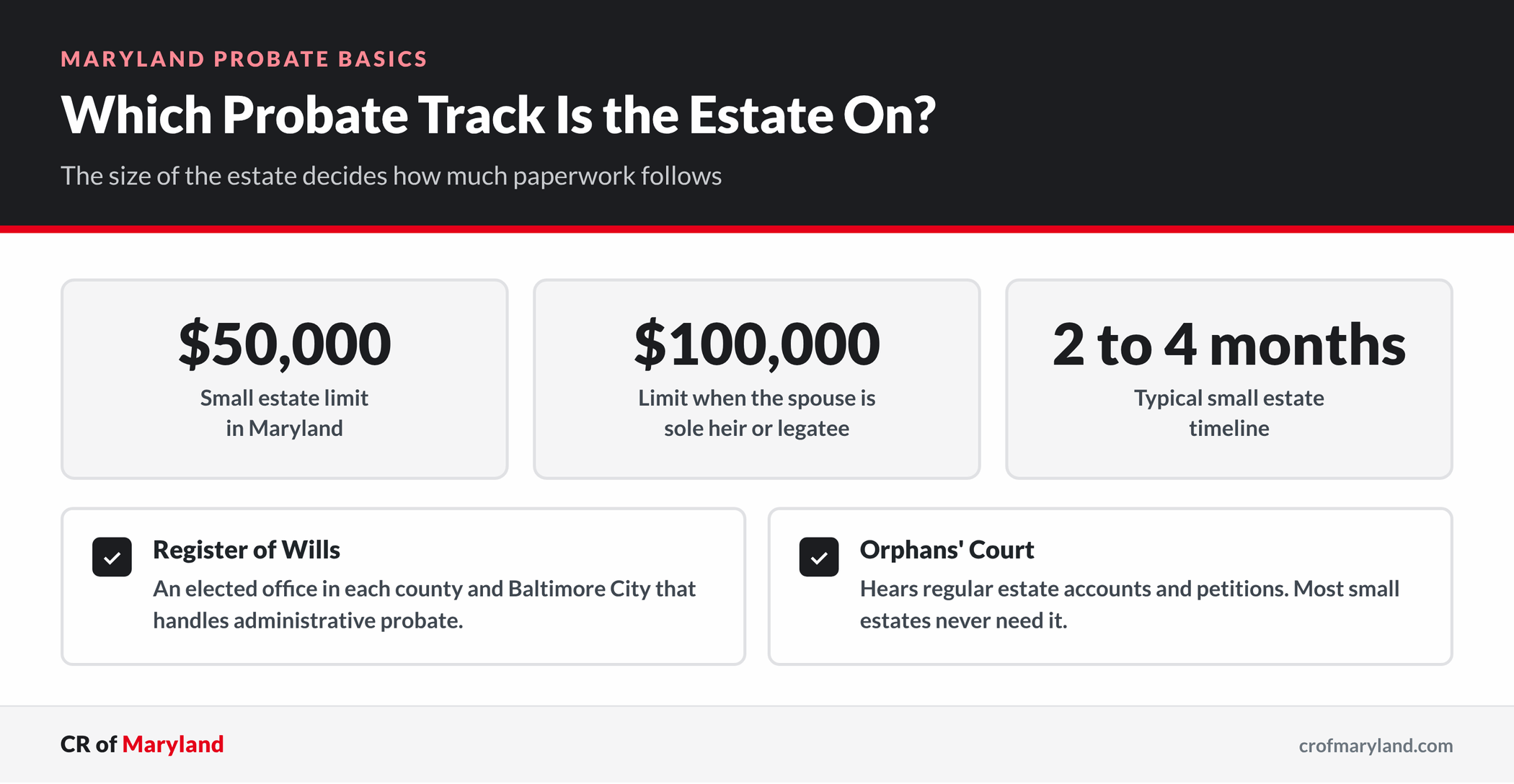
Fifty thousand dollars is where Maryland draws the line between a regular estate and a small estate, and that limit doubles to $100,000 when the surviving spouse is the sole heir or legatee. Probate itself is the supervised process of moving what a person owned to whoever inherits it, once debts and taxes are settled.
People who move here from other states are often surprised that Maryland probate doesn’t start with a judge. Each county and Baltimore City elects a Register of Wills every four years, and that office’s staff handles administrative probate directly. Regular estate accounts and petitions do go before the Orphans’ Court. Most Small Estates and modified administration estates, though, never need the court at all.
When a house is titled in the decedent’s name alone, it’s almost always a probate asset. So a $430,000 Maryland property can’t legally be sold by an heir until someone is appointed with the authority to sell it.
A while back I sat with a widow at a kitchen table in Essex. She was three months behind on the mortgage, an auction date was already on the calendar, and her late husband’s tools still hung in the garage. We got her to the Register of Wills in Towson that same week. Without probate opened, she had no standing to sign anything.
Opening probate in Maryland isn’t a punishment. It’s how someone gets legal authority over the house, the bank accounts and the car. Without it, no title company in this state will insure a sale, however friendly the family is.
Do All Maryland Assets Have to Go Through Probate?
No. That’s usually the first good news I get to give. A surprising amount of what a Maryland family owns never touches probate at all.
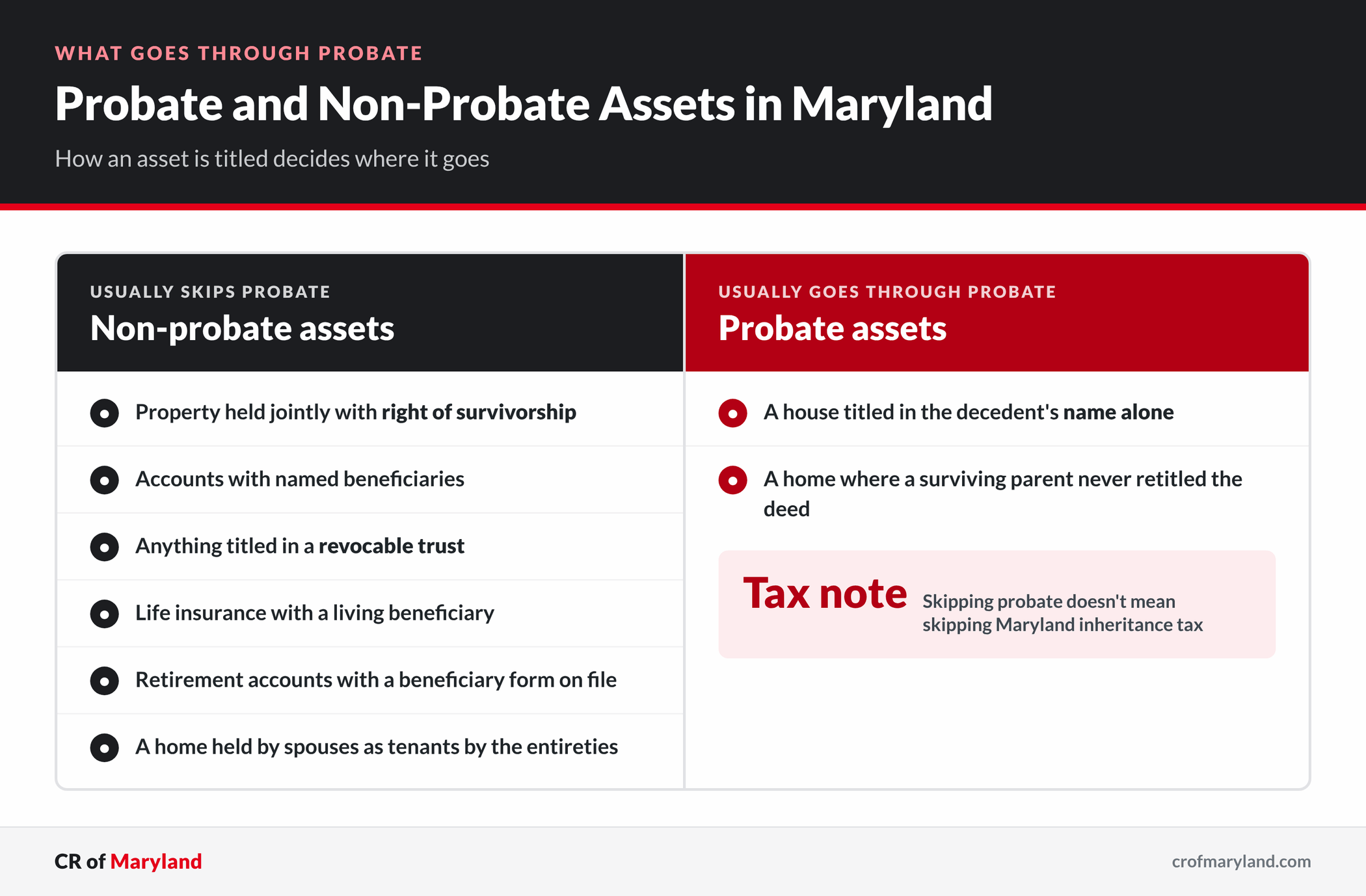
Property held jointly with right of survivorship, accounts with named beneficiaries, and anything titled in a revocable trust all count as non-probate property, and each passes straight to the named beneficiaries or joint owners. A life insurance policy with a living beneficiary skips probate entirely. So does a retirement account with a beneficiary form on file.
The house is where families usually get tripped up. Maryland married couples often hold real estate as tenants by the entireties, so the surviving spouse keeps it outright with no probate. A parent who outlives a spouse and never retitles the deed, on the other hand, leaves the home squarely in the probate estate.
Do you know exactly how your deed is worded today?
Then there’s the Maryland inheritance tax question. The Information Report exists to flag non-probate assets that may owe Maryland inheritance tax. Avoiding probate and avoiding tax are two different claims, and a lot of online advice blurs them.
I’d push back on adding an adult child to a Maryland deed just to dodge probate. You’re giving an ownership stake to someone whose creditors and divorce lawyer now have a target, and you may hurt the capital gains basis the heir would otherwise get. The Register of Wills publishes a plain guide to administering Maryland estates. Read it before you move any title around.
How Does the Probate Process Work in Maryland?
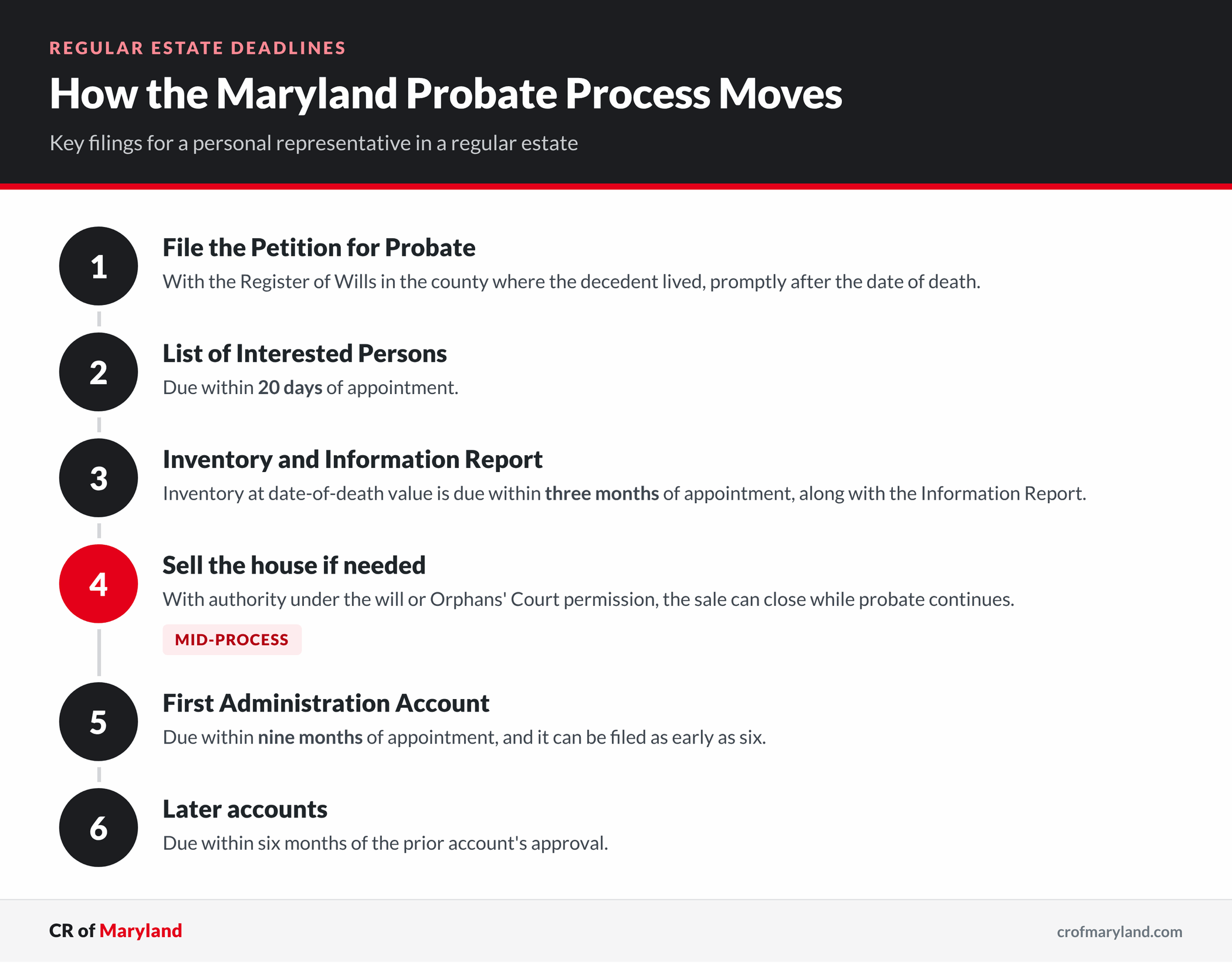
Soon after the death, someone files the Petition for Probate with the Register of Wills in the county where the decedent lived, along with the right schedule and supporting papers.
Deadlines come fast once a personal representative is appointed. In a regular estate, the List of Interested Persons must be filed with the Register of Wills within 20 days of appointment. The same person then has three months from appointment to file a complete Inventory of estate assets at date-of-death value. The Information Report, which covers assets not held solely in the decedent’s name, must be filed with it.
An appraisal or a broker’s opinion of value sets what the Maryland property was worth on the day of death. That number follows the estate through every later filing.
Next comes the account. A regular estate owes its first Administration Account within nine months of appointment, though you can file it as early as six months in. Each later account is due within six months after the prior one is approved.
Selling the house usually happens in the middle of all this, not at the end. A personal representative with authority under the will, or with permission from the Orphans’ Court, can list and settle on the property while probate administration continues. The sale proceeds go into the estate account and show up on the next accounting.
What Does a Maryland Executor or Administrator Do?
Even the job title is confusing. Maryland’s statutes never use the word executor. The official title is personal representative, whether or not there’s a will, and you’ll see it on every form the Register of Wills hands you.
Expect to post a probate bond in most cases. It works like an insurance policy, protecting beneficiaries, estate creditors and the State of Maryland against errors or fraud in the administration.
The personal liability is real. A taxing authority or creditor can hold a personal representative responsible, out of pocket, for obligations the estate left unpaid.
One mistake I keep seeing is a personal representative who leaves the vacant Maryland house uninsured, or on a standard homeowners policy that quietly excludes vacancy. One burst pipe in a Frederick County split-level in January will wipe out more value than any negotiation could. Call your carrier the week you’re appointed and ask for vacant-property coverage.
Upkeep doesn’t pause during probate either. Families who assume otherwise find out when the county sends a citation.
Maybe you can’t maintain a property from three states away. Our team at CR of Maryland I LLC can buy the house as it stands, which spares the estate carrying costs that pile up every month probate stays open.
How Long Does Probate Take in Maryland?
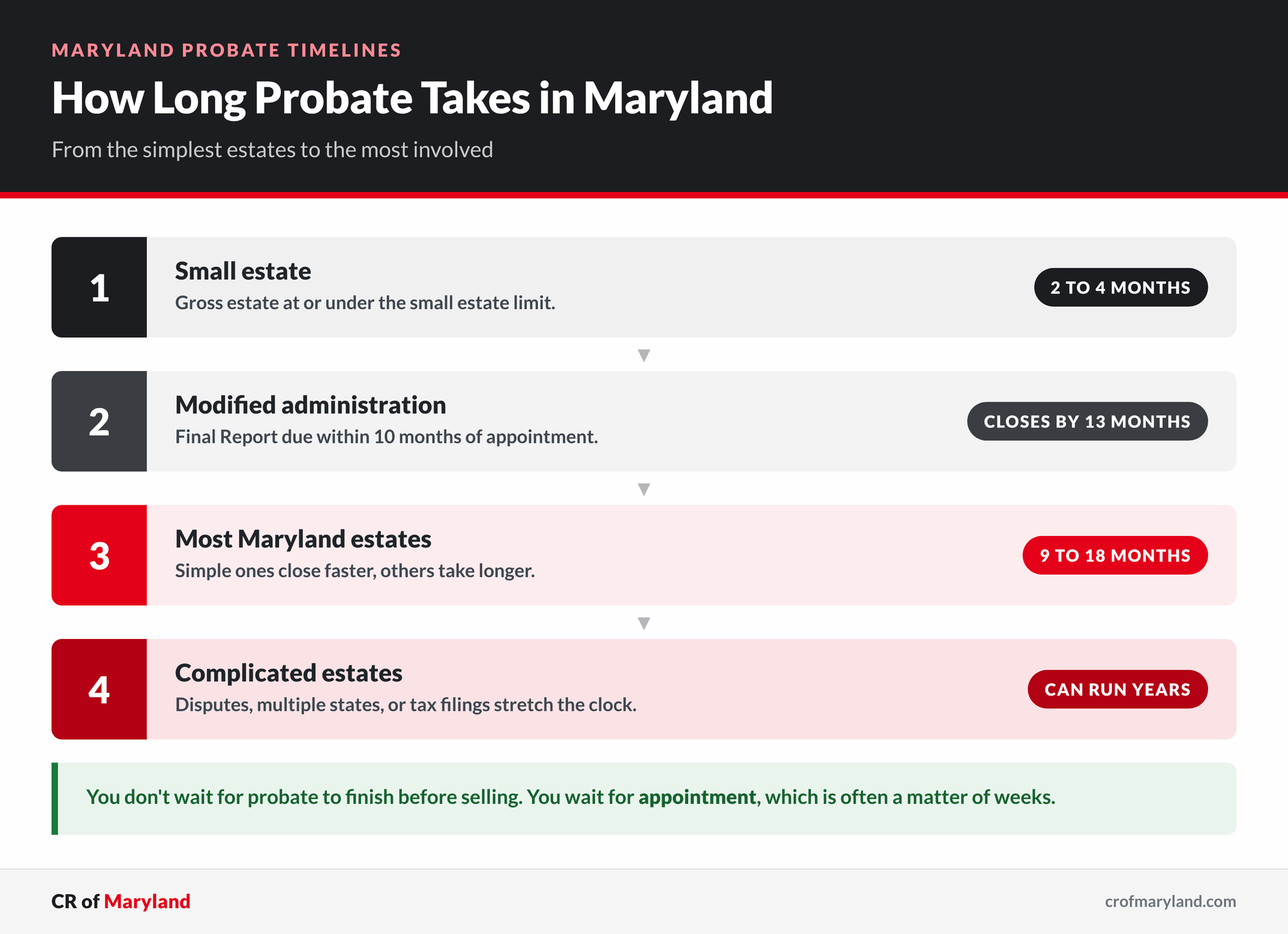
Anyone promising a six-week probate on a Maryland house with a mortgage is selling something. Most estates here take between 9 and 18 months. Simple ones close faster and complicated ones run for years, while small estates typically wrap up in two to four months.
Creditors set the pace. Claims against a Maryland estate generally have to be filed by the earlier of two deadlines. One is two months after the personal representative sends notice to a known creditor, and the other is six months from the date of death. That second deadline runs whether or not anyone gave notice or even opened an estate. The clock starts at death, not at appointment. A family that waits two months to file has already burned a third of it, and I’ve watched families assume the clock would wait for them.
Modified administration is the faster lane. The Final Report is due within ten months after appointment, and the estate should close no later than 13 months from appointment. It’s open only when the people inheriting fall into a narrow class: a spouse, children and other lineal descendants, parents, grandparents, or siblings.
One fact changes most families’ plans. You don’t have to wait for probate to finish before selling the Maryland house, because you only need to wait for appointment, which often takes just weeks. Heirs get paid on the remaining probate timeline, not on the day a deed gets signed.
I’ve closed on Maryland properties where the estate stayed open a full year afterward. The Register of Wills still got its paperwork. Running the two on separate schedules hurt nobody.
What Factors Affect How Long Probate Takes in Maryland?
“My brother’s estate in Pennsylvania took four months, so why is my mother’s Maryland probate dragging?” Usually the answer is the estate’s own complexity.
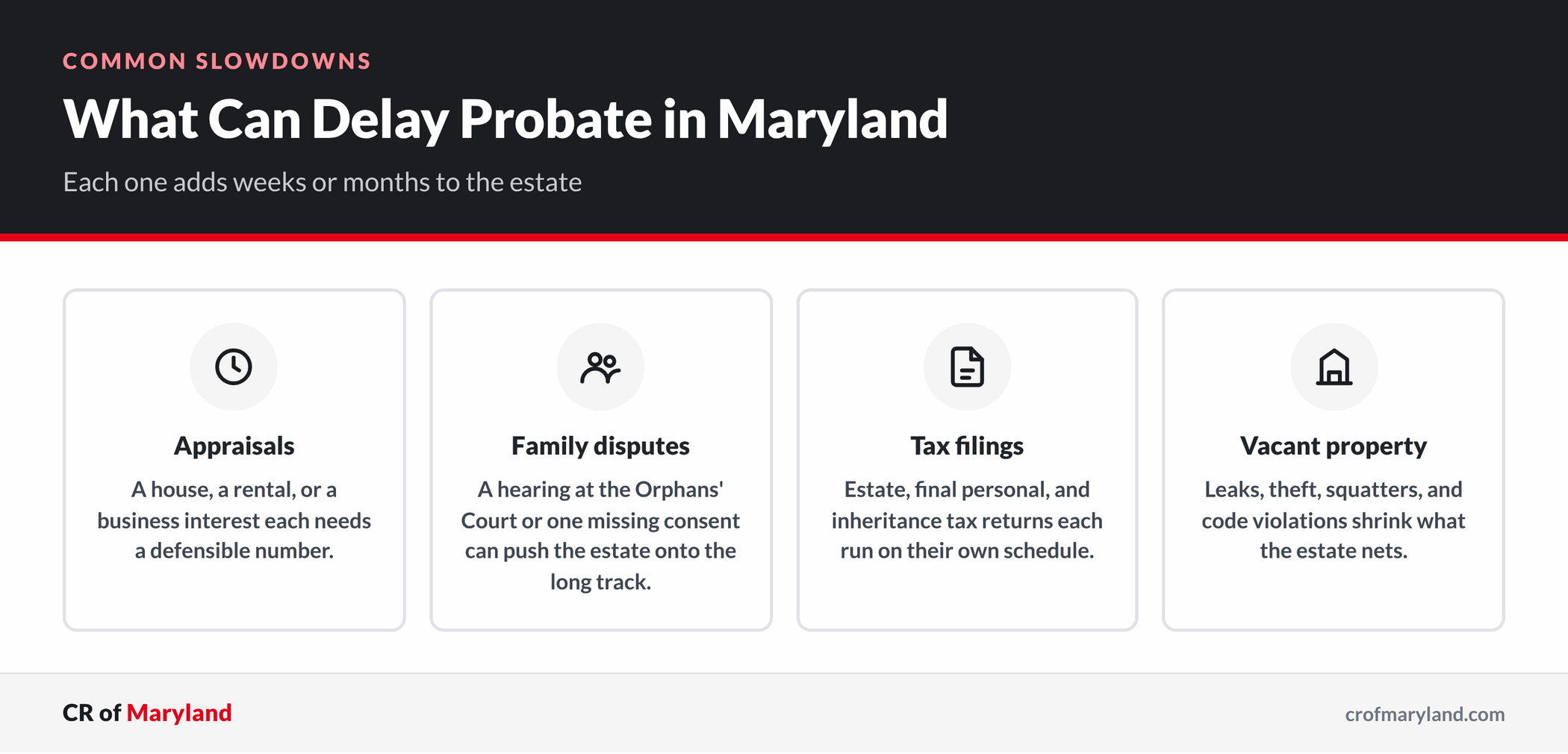
Every asset needs a defensible number, whether it’s the house, a rental in another state, a closely held business interest or a coin collection. Probate appraisals take weeks to schedule. Property in more than one state means ancillary probate there too, under that state’s laws instead of Maryland’s.
Family disagreements can land in front of the Orphans’ Court, and a hearing date is never next week. One sibling who won’t sign a consent can bump an estate out of modified administration and back onto the long track.
Taxes add their own rhythm. A federal estate tax return, a final personal return and Maryland inheritance tax for non-exempt beneficiaries each run on separate filing schedules, and one missing K-1 can idle an estate for months.
The house also has to sell into this market, and 2026 hasn’t been an easy year for sellers. Maryland home sales dropped 16.5% in October 2026 from a year earlier, 4,785 homes versus 5,731, while the median sales price eased 1.7%. Active inventory reached 19,236 homes that month, up 22.8% year over year, and median days on market stretched from 17 to 21.
What does a softer market do to probate? It lengthens the sale leg. An estate that budgeted sixty days to liquidate the house now budgets ninety, and the personal representative carries the taxes and insurance the whole time.
What Challenges Can Delay Probate in Maryland?
Miss the Final Report deadline under modified administration and you lose that track. The election gets revoked, and the estate reverts to regular administrative probate, bringing back the inventories and accounts you thought you’d escaped. That one lapse can add half a year.
The List of Interested Persons has to be accurate, too. If there’s a half-sibling nobody has talked to since the 1990s, someone has to find them before any distributions happen.
Meanwhile, a vacant property collects problems. Think copper theft, a roof leak, squatters in a Baltimore City rowhome or a code violation on a Prince George’s County bungalow. None of that stops probate on paper. Each one still shrinks what the estate nets and hands the heirs something new to argue about.
If the decedent was behind on payments, the servicer’s foreclosure track runs on its own, separate from the probate process. That’s the most urgent situation I see.
Local numbers show the drag. Baltimore’s median sale price was $227K over the three months ending October 2026, down 2.5% year over year. Homes sold after 49 days on average, versus 45 a year earlier. Montgomery County homes sold after 47 days over the same stretch, up from 38 the prior year. An estate that lists in Silver Spring waits out that marketing period, then adds thirty to forty-five days for a financed buyer to close. That’s three months before a dime reaches the estate account.
Mixing estate money with personal money is another trap. A personal representative who does it creates an accounting problem, and the Register’s auditors will catch it.
How Can You Avoid or Shorten Probate in Maryland?
A landlord in Hagerstown inherited his aunt’s duplex and listed it twice with two different agents. Both listings expired without an offer, mostly because the basement unit had a dated kitchen and a tenant who refused Saturday showings. By month nine, he was paying two sets of utilities out of his own pocket.
Shortening probate starts at the front end, so file promptly. The six-month creditor window runs from death whether or not anyone has opened an estate, and every week you hesitate is a week you don’t get back.
To elect modified administration, the personal representative and every residuary beneficiary under the will (or every heir, if there’s no will) must consent within three months of appointment.
A revocable trust can shrink or avoid probate for the assets it holds. If you own real estate in more than one state, it may also spare your family a separate ancillary probate in each one. The Register of Wills publishes a straightforward guide on revocable living trusts, and the People’s Law Library walks through the full estate administration timeline.
An estate that turns a Maryland property into cash in the first few months stops bleeding carrying costs, and every later filing gets simpler. That Hagerstown landlord eventually sold the duplex as-is to a direct buyer, tenant and dated kitchen included. It closed in under three weeks. I’ve seen that kind of turnaround calm a family down fast. Companies like ours exist for exactly this situation, where the property doesn’t show well, the heir lives far away and nobody wants the probate clock to run longer.
Run your monthly carrying costs before you assume a listing will net more.
Frequently Asked Questions
Why Do People Say You Have to Wait Six Months After Someone Dies?
The six months come from the creditor claim window. No rule about selling real estate is involved. A personal representative who pays out heirs before that window closes can end up personally on the hook for a claim that arrives later. Selling the house is a separate matter, because the proceeds just sit in the estate account until it’s safe to distribute them.
Can I Sell an Inherited Maryland House Before Probate Is Finished?
Usually, yes. You need to be formally appointed as personal representative with authority to sell, either under the will or with Orphans’ Court approval. After that, a title company can insure the transaction, and you can close while the rest of the probate administration keeps moving on its own schedule.
Does the House Have to Be Empty Before We Can Sell It?
Not for a direct sale. Agents will push for a cleared, staged property because retail buyers respond to it, and for that audience they’re right. If the family can’t face the cleanout, selling as-is to a local buyer who takes the contents along with the house is a legitimate choice.
Who Pays the Mortgage and Taxes While the Maryland Probate Is Open?
The estate pays, out of estate funds, and the personal representative has to make sure those payments go out. When cash runs short, heirs sometimes advance the money, or the house gets sold earlier to stop the bleeding. Lenders don’t pause for a death, so a loan that was already behind needs attention in the first few weeks.
If you’ve inherited a Maryland house and can’t decide whether to fix it up, list it or just be done with it, I’m happy to talk it through. We can walk the property and tell you honestly what it would bring on the open market and what we’d pay for it as-is. Take that to your family or your probate attorney and do whatever makes sense. There’s no pressure, and no hard feelings if you’d rather wait out probate and list in the spring.
Talk With CR of Maryland About an Inherited House
We’re glad to walk the property with any personal representative weighing the options. Contact CR of Maryland I LLC with a few details about the house, or fill out the form below.