A sheriff’s deputy stood in a Dundalk rowhouse doorway while a landlord argued that the sofa, the dresser, and six bins of belongings in the back bedroom were his now. He was wrong about that. Maryland handles leftover belongings differently than almost any state I’ve worked in, because the rules shift with the county you’re standing in. Maybe you own a rental, inherited a house with someone else’s belongings still inside, or let a relative store things in your garage. The timeline you think you have probably isn’t the one the law gives you.
What Does Maryland Law Say About Abandoned Belongings?
Throw out the wrong box and you can end up defending a detinue claim in District Court, paying for a stranger’s furniture and your own lawyer. That’s the real stake. Maryland doesn’t hand landlords a clean statewide countdown clock for belongings the way some states do. The gap in the statute is where people get hurt.
Start with the lease itself. Maryland’s Real Property Code § 8-208 bars a lease clause that lets a landlord take possession of the premises or the tenant’s personal property. The exception is narrow: the lease has to be terminated, and the tenant has to have abandoned the personal property without the benefit of formal legal process. Both conditions, not one. A lease clause that says otherwise is dead weight. You can read the full statute text on the Maryland General Assembly site.
Where things get genuinely local is after a court gets involved. If a landlord wins a failure-to-pay-rent case, the judge orders the tenant out within 4 days of the trial. Once that deadline passes, the landlord can ask the court for a warrant of restitution directing the sheriff to return possession and remove the tenant’s belongings. You then have 60 days from the judgment to request that warrant, and the signed warrant expires after the same stretch.
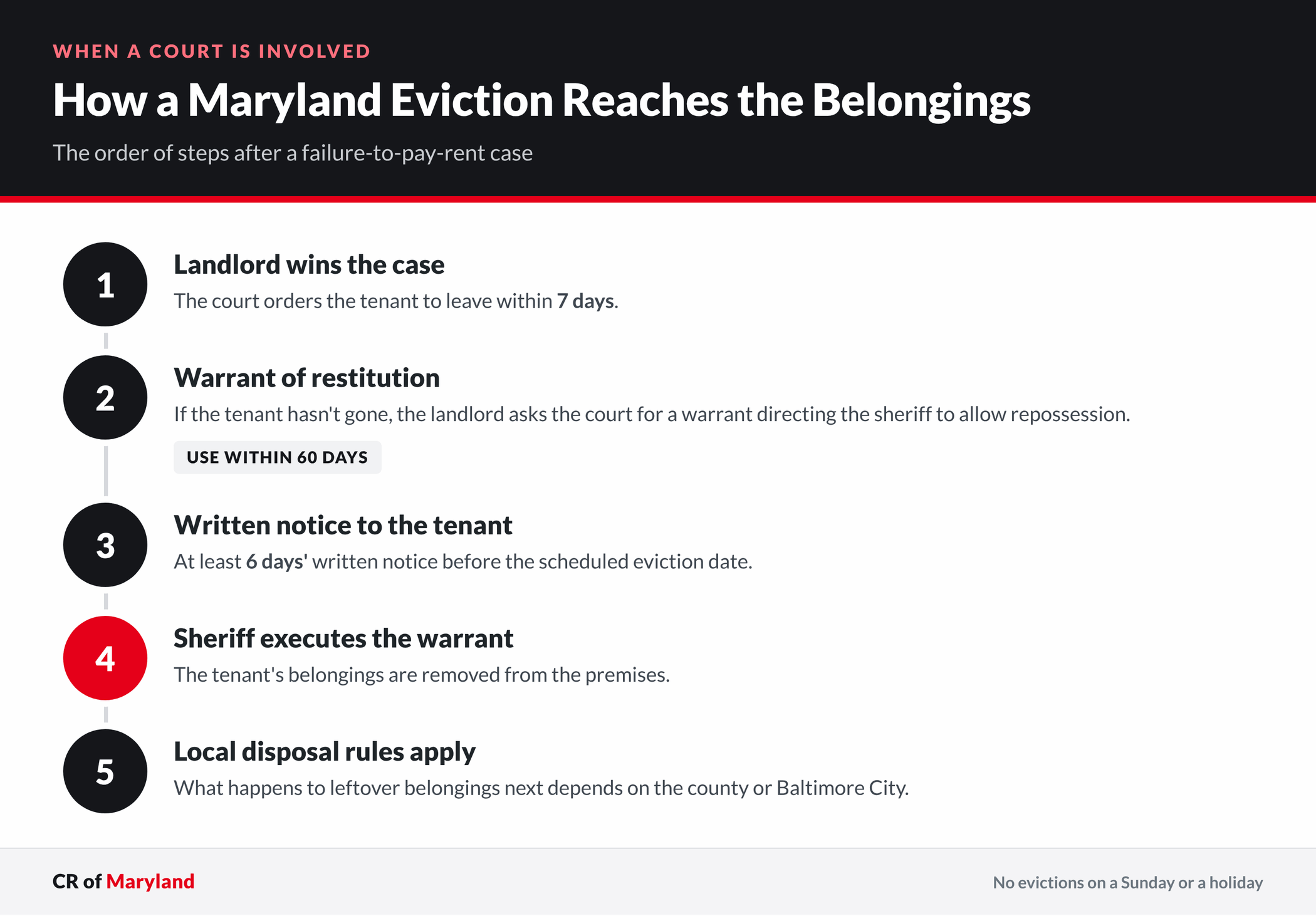
Notice what the statute never says: a number of days you must store someone’s belongings. Plenty of blog posts online will confidently tell you 15 days, or 30, or 45. Those numbers come from other states’ codes and get copied around. For Maryland, the timeline for belongings depends on whether a court order was executed and which county you’re in.
Maryland’s Department of Housing and Community Development publishes a Tenants’ Bill of Rights that lays out the eviction framework in everyday terms. Read it before you touch anyone’s belongings. Your county’s District Court clerk can also confirm current filing requirements.
How Long Can Someone Leave Their Belongings on Your Property in Maryland?
A Baltimore City landlord I know had the sheriff out on a Tuesday and had the unit broom-clean by Thursday. A federal court has since put that kind of fast cleanout in doubt. An Anne Arundel County owner who waited two days after an eviction would be fine under the county’s newer rule. Same state, different clocks.
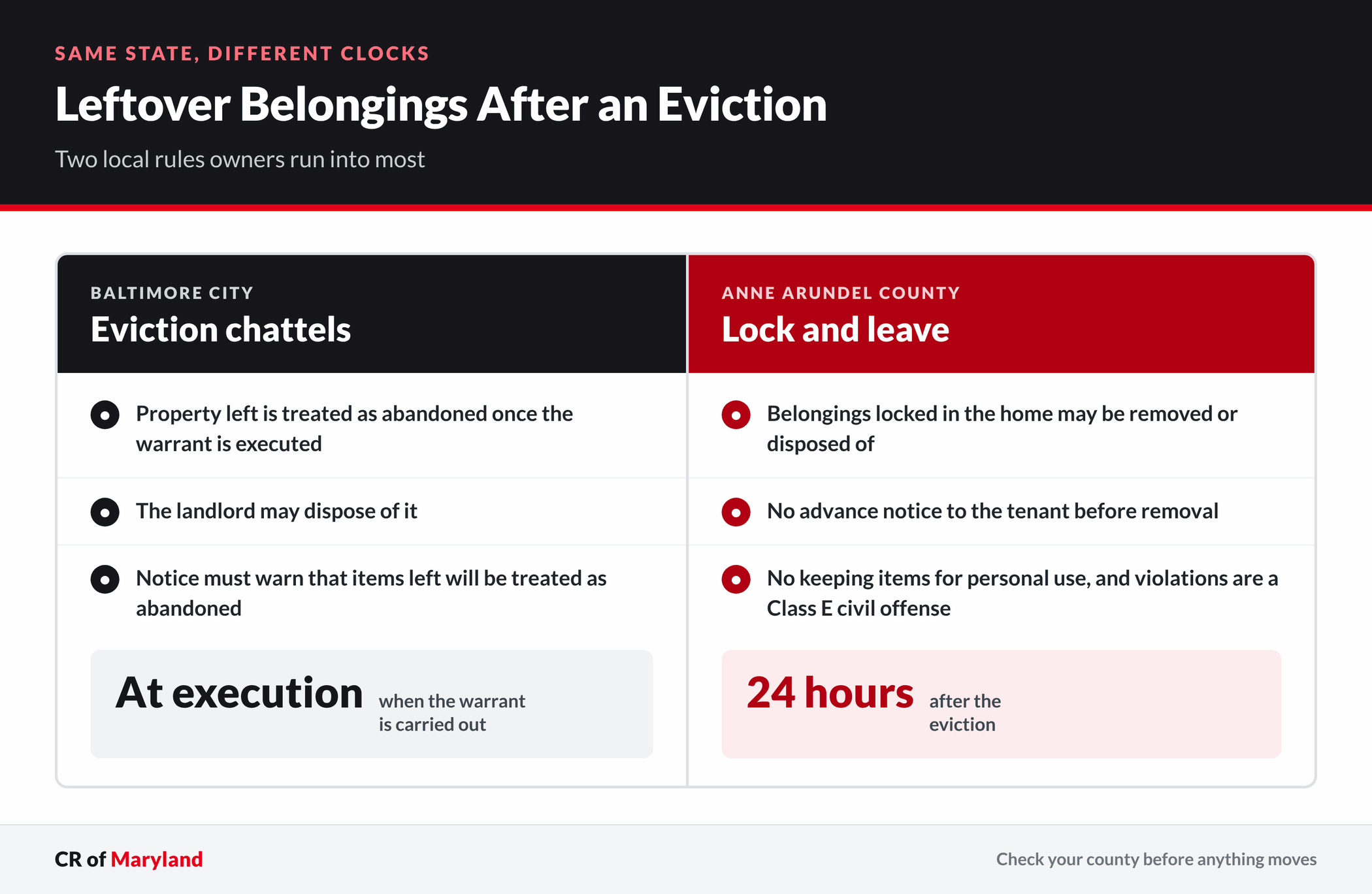
Baltimore City’s code still has the fastest clock in Maryland, and it’s on shaky ground. On paper, any property the tenant leaves is considered abandoned the moment a warrant of restitution is executed. Baltimore even has a term for the leftover belongings: “eviction chattels.” In 2024, though, a federal appeals court upheld a ruling that the city’s law violated evicted tenants’ constitutional rights. The city is now moving to pay $11 million to settle the class action that followed. The People’s Law Library’s page on Baltimore City disposal rules walks through the notice a landlord has to give. City lawmakers are weighing a bill that would give tenants time to reclaim their things, so talk to a lawyer before you throw anything out.
Cross into Anne Arundel County and the clock changes. Since July 2026, the county’s “lock and leave” law has the landlord change the locks with a deputy present and keep the tenant’s things inside. A landlord may then remove or dispose of those belongings 24 hours after the eviction, with no further notice. Nobody can keep any of them for personal use, and breaking the law there is a Class E civil offense under the county code.
So how long can belongings stay? If no court order exists, there’s no clock at all, and that’s the scenario that traps most Maryland homeowners. A relative storing a motorcycle in your Towson garage, an ex-roommate’s boxes in the basement, a former tenant on an expired lease: none of that gets resolved by waiting.
Not long ago I bought a brick colonial in Catonsville from two adult children whose mother had moved into assisted living. They’d chased rent from a tenant for a year and a half and never wanted to be landlords. The detached garage was still full of the tenant’s belongings plus their mom’s Christmas decorations. They were done. We closed with the belongings sorted the right way instead of the fast way.
Does your lease exist in writing? That single question decides which legal path applies in Maryland, and people get it wrong constantly.
What Happens to Belongings Left Behind After Someone Moves Out?
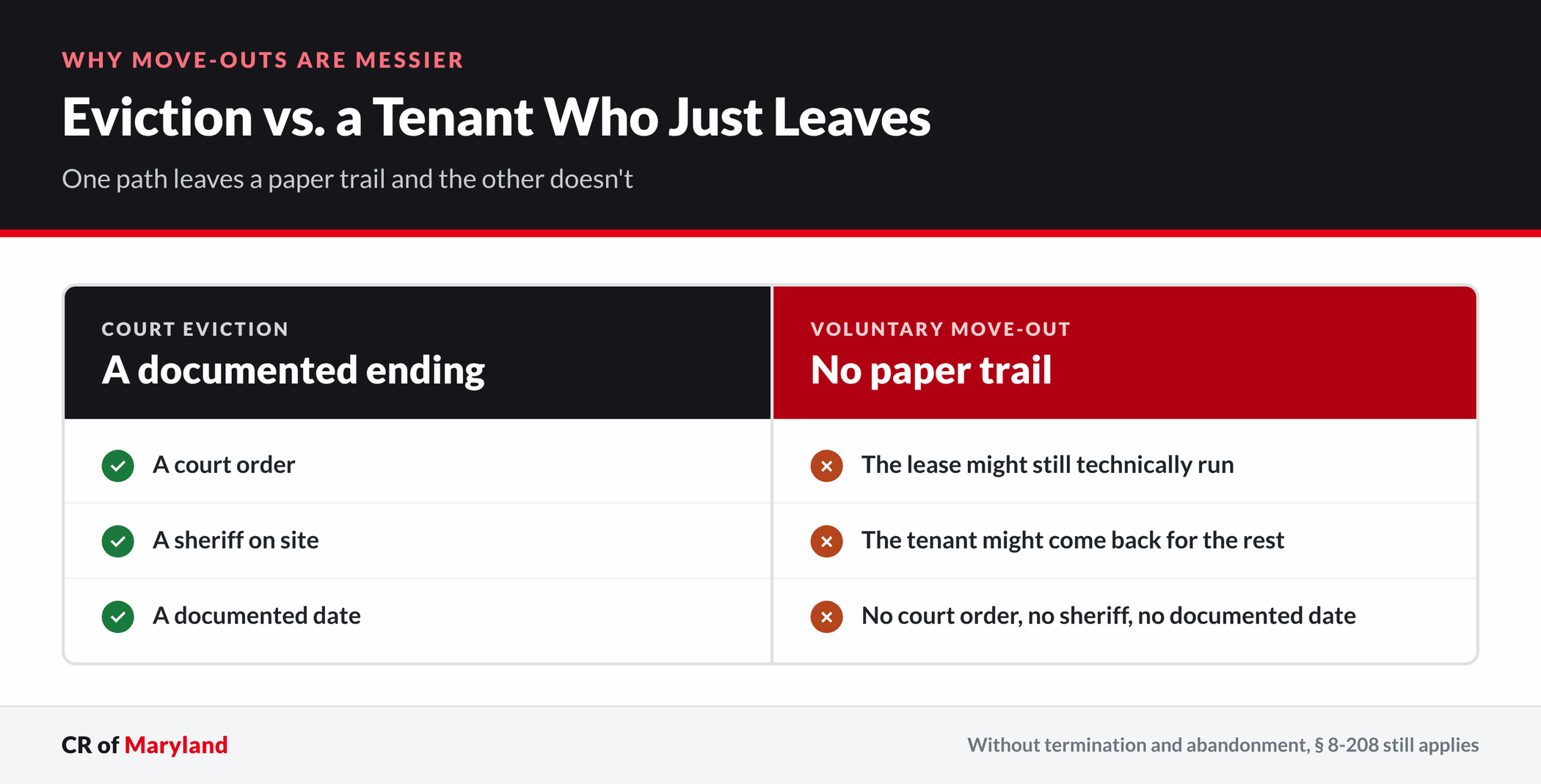
Voluntary move-outs are legally messier than evictions in Maryland, which surprises a lot of owners.
An eviction gives you a court order, a sheriff, and a documented date. A tenant who just leaves gives you none of that. The lease might still technically run. They might come back Saturday for the rest of their belongings. Without a termination and clear abandonment, § 8-208 still limits what you can do with their stuff.
What I’ve watched happen over and over: an owner finds the keys on the counter, assumes the tenancy ended, and hauls everything to the dump. Three weeks later a letter arrives claiming a lost laptop and a grandmother’s jewelry box. Now the owner is proving a negative without an inventory.
Belongings left after a sheriff-supervised eviction land in a different category. Once possession is handed back, a handful of Maryland jurisdictions treat what’s left as abandoned, and law enforcement won’t guard it. Evictions also can’t happen on a Sunday or a holiday in Maryland, which matters when you’re coordinating a cleanout crew.
Inherited properties come with their own baggage. An heir in Hagerstown or Silver Spring often holds a house full of belongings that belong to an estate, not to them personally. Distribution is up to the personal representative. Hauling a deceased parent’s belongings before the estate is settled can create friction with siblings that lasts years. Slow down there.
Mixed-ownership situations deserve a flag too. When a tenant’s belongings sit next to the owner’s belongings in the same basement, document which is which before anything moves. Photographs timestamped on your phone cost nothing.
The Maryland Judiciary’s housing self-help page outlines which court forms apply to each scenario. Worth bookmarking before you need it.
How Do You Notify Someone About Their Leftover Belongings?
“Can I just text them?”
Text them, sure, but don’t stop there. Written notice to the last known address is the backbone of protecting yourself in Maryland. A text message alone makes a thin exhibit if this ends up in front of a judge.
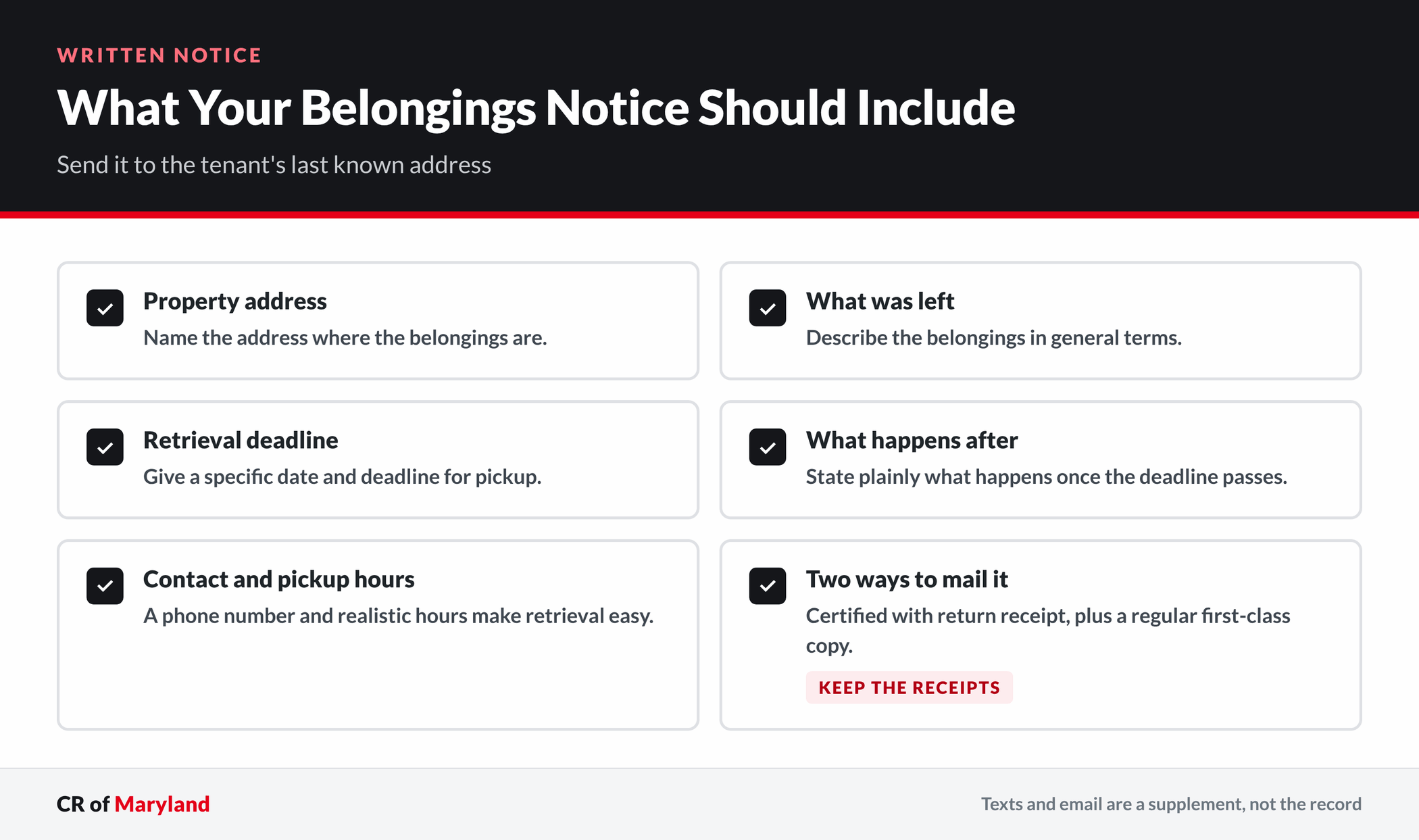
Mail it certified with return receipt, and send a regular first-class copy too. Certified mail gets refused all the time, and the plain copy still shows you sent it. Keep the green card, keep the receipt, keep a photo of the sealed envelope.
Your notice should name the property address, describe the belongings in general terms, and give a specific retrieval deadline. Say plainly what happens after that date. Include a phone number and realistic pickup hours. If someone genuinely wants their belongings back, you want retrieval to be easy, not a scheduling standoff.
Eviction notices follow a tighter script in Maryland. After the court issues a warrant of restitution, state law requires the landlord to give the tenant at least 6 days’ written notice before the scheduled eviction date. Baltimore City asks for more: the notice goes out by mail at least 14 days ahead and gets posted on the door at least a week before. Each notice has to include the court case number, the tenant’s name and the leased property address. It must also warn that anything left in the dwelling will be treated as abandoned once the warrant is executed. Skip those requirements and the warrant’s execution can be delayed or the warrant vacated.
Email counts for something if the tenant gave you an email address in the lease agreement. Use it as a supplement, never as your only record.
One more notification worth making: tell your attorney before you tell the tenant. A twenty-minute call with a Maryland landlord-tenant lawyer runs far cheaper than a civil liability judgment. The good ones will review your notice language in a single sitting. I’ve found this saves a lot of back-and-forth later.
What Should You Do Before Removing Someone’s Belongings?
Owners picture a dumpster, a weekend, and a clean house by Monday. Then the crew pulls a locked safe out of a closet, or a vehicle title turns up in a shoebox, and the weekend plan becomes a legal question. Almost every cleanout hits that exact pivot point.
Build a checklist and work it in order. Photograph every room before anything moves, including closets and the inside of drawers. Video walkthroughs are even better, so narrate the date out loud as you go. Then write an inventory, item by item, with condition notes on anything that looks valuable.
Separate out documents and keepsakes. Birth certificates, passports, medical records, photo albums, military discharge papers, urns: these carry outsized weight with a judge even when their resale value is zero. Box them, label them, store them dry.
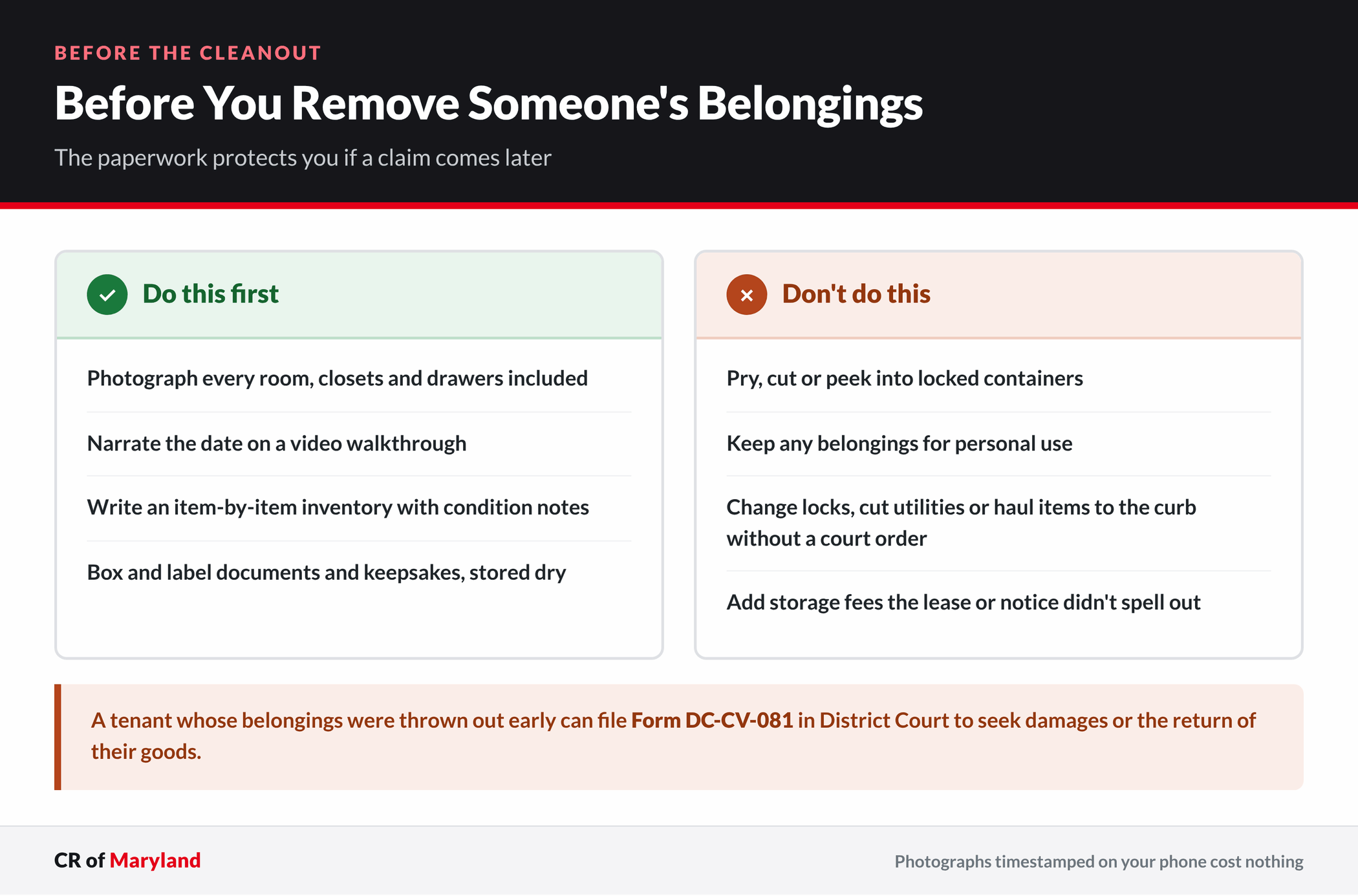
Locked containers stay locked. Don’t pry, don’t cut, don’t peek.
Storage costs money, and some Maryland landlords build a storage fee into the lease or the notice. Put that language in the lease agreement before you ever need it, and have a lawyer look it over. Adding fees after the fact rarely survives scrutiny.
Does the property have a mortgage, a tax bill, and a vacancy running at the same time? Carrying costs pile up as you sort belongings, and that pressure pushes people into bad decisions. Maryland’s market isn’t helping. The state posted an October 2026 median sale price at $430,000 and sales down 16.5% year over year according to Bright MLS data compiled by Maryland REALTORS®. A property sitting empty while you argue about belongings isn’t cheap to hold.
That’s where you treat selling as-is as arithmetic rather than surrender. At CR of Maryland, we buy houses across the state in their current condition, belongings included. It’s worth a look once the cleanout math stops working. A house handed over with its contents intact isn’t a dealbreaker for us.
What Are Your Legal Risks for Disposing of Belongings Too Soon?
A detinue complaint is the piece of paper that should make you careful. Any tenant whose belongings were thrown out early can file one on the District Court’s standard complaint form, DC-CV-001. The claim asks for the goods back, or their value, plus damages. Detinue claims are cheap to file and painful to defend without an inventory.
Conversion is the other exposure. Take someone’s property and treat it as your own, and you’ve handed them a civil liability claim with your name on it. Keeping abandoned belongings for personal use is specifically prohibited under Anne Arundel’s law. Elsewhere it’s still a conversion risk, and that includes the “nice” dresser you figured you’d use in the next unit.
Self-help is the deeper trap. Changing locks, cutting utilities, or hauling belongings to the curb without a court order invites a lawsuit from the tenant, however much rent they owe you. Maryland wants a judge and a sheriff involved. The sequence exists to protect you as much as the tenant.
Counties enforce differently. What’s lawful on a Tuesday in one Maryland jurisdiction draws a penalty in the next. Verify with your county’s District Court or housing office rather than a neighbor’s advice.
Market timing stacks onto all of this. Maryland’s active inventory hit 19,236 homes in October 2026, up 22.8% from a year earlier, with months of supply climbing from 2.9 to 3.6. More competition means a cluttered listing sits longer. On Maryland’s Eastern Shore, October 2026 median days on market reached 27 days versus 19 a year earlier. Belongings in every room make that stretch further.
An heir in Glen Burnie I worked with had already burned through two agent listings, both expired, with zero offers across the whole run. Buyers kept walking out of the finished basement, where her father’s model train layout filled the floor and nobody wanted to touch it. She sold as-is and left the trains to a collector who came for them later.
Frequently Asked Questions About Leaving Belongings on Someone’s Property in Maryland
Sit down with me at your kitchen table and I’ll tell you the same thing I tell everyone: the law here rewards patience and paperwork, not speed.
Can I Keep a Tenant’s Belongings in Maryland If They Still Owe Me Rent?
No. Holding someone’s belongings as leverage for unpaid rent isn’t how Maryland handles it, and the lease limits in the Real Property Code were written to stop exactly that. Unpaid rent is a money claim you pursue through the District Court, separate from any question about belongings. Mixing the two is how landlords turn a collectible debt into a lawsuit against themselves.
Do I Have to Store Belongings If Someone Moved Out Voluntarily?
Maryland’s statute doesn’t set a fixed storage period for a voluntary move-out, which cuts both ways. You’re not locked into a long holding window, but you also can’t point to a statutory deadline as your defense if someone sues. Send written notice, give a reasonable retrieval period, photograph and inventory everything, then proceed. A landlord-tenant lawyer in your county can review that plan for a modest fee.
What Happens to Belongings When the Property Is in Probate?
Belongings inside an inherited Maryland house generally belong to the estate until the personal representative distributes them. Heirs who clear out a parent’s belongings before the estate is administered create problems with the Register of Wills and with each other. Check with the Orphans’ Court or Register of Wills in the county where the house sits before scheduling a dumpster.
Can a Lease Agreement Set My Own Deadline for Leftover Belongings?
Your lease can set notice procedures, storage fees, and retrieval logistics, and a well-drafted lease agreement makes everything downstream easier. What it can’t do is override the statutory limits on taking possession of a tenant’s personal property. A clause that lets you seize belongings without termination and abandonment won’t hold up under Maryland law, however clearly it’s written.
Does It Matter Which Maryland County the Property Is In?
It matters a lot, and online guides tend to flatten that detail out. State law sets the framework for leases and evictions uniformly. Baltimore City and some counties have layered their own disposal rules on top for what happens after a warrant is executed. Call the District Court clerk or county housing office where the property is located and ask them directly.
Will Leftover Belongings Hurt My Chances of Selling the House?
Traditional buyers react badly to full rooms. Appraisers and inspectors have a harder time working around stacked belongings, financed buyers get nervous about what’s hiding behind them, and showings fall flat. Selling directly to a local investor removes that problem, since cash buyers price on the property and structure rather than presentation. Owners who go that route often leave belongings behind by agreement and never rent a truck.
Should I Hire a Lawyer Before Disposing of Belongings?
If the belongings have real value, if there’s any dispute about who owns them, or if an eviction is involved, yes. Maryland landlord-tenant lawyers handle these questions constantly, and most will give you a straight answer in one phone call. Compare that cost against a conversion judgment and the math isn’t close.
Selling a Maryland House With Someone Else’s Belongings Inside
A full house is harder to sell in a slower market. Maryland homes took a median of 21 days to sell in October 2026, up from 17 a year earlier, according to Maryland REALTORS. Rooms packed with a former tenant’s things can add to that wait.
You don’t have to empty the place first. We buy houses in Baltimore with the contents still inside, once the legal side of the belongings is sorted out.
The same goes for owners outside the city. Homeowners across Maryland can sell as-is and leave the cleanout to us. If your rental sits in Anne Arundel County, we buy houses in Glen Burnie with the contents left inside.
Talk With CR of Maryland About a House Full of Belongings
If you’re stuck with a former tenant’s things or an estate that isn’t settled, we’re happy to listen. Contact CR of Maryland and tell us what’s left in the house and where it stands. You can also fill out the form below, and we’ll follow up with a fair cash offer you’re free to turn down.
Helpful Maryland Blog Articles
- Who Pays the HOA Fees at Closing in Maryland
- Selling a House With Septic Tank Problems in Maryland
- Appraisal Required Repairs in Maryland
- Can you stop a Foreclosure once it starts?
- Can I sell my House and still live in it?
- Selling a House With a Pending Lawsuit in Maryland
- Can I Sell My House if I Have Equity Release in Maryland?
- Can an HOA Foreclose on a House in Maryland
- Selling Investment Property in Maryland
- Can a Seller Refuse Repairs after Inspection
- Should I Remodel my Kitchen before Selling
- How Long Can Someone Leave Their Belongings on Your Property in Maryland